Field notes · No. 24 · G30
By the ChinaTravel.fly field desk 6 min read Updated Nov 2026

- Paper
- Bring it¥1–2 a pack at any shop
- Pan
- Squatsit-down in malls and stations
- Bin
- Use itpaper does not go in the bowl
- Cost
- Freea few rural ones still charge ¥1
Nobody writes about toilets until they need one, and then it is too late for research. So, the short version: assume a squat pan, assume no paper, assume a bin beside the pan that you are expected to use, and assume that the mop in the corner is the cleaner's property and not an invitation.
The squat, and how not to fall over
A squat pan is a ceramic trough set into the floor with raised footprints on either side. The technique is the same as it has been for a thousand years: feet flat on the ridges, facing the hood, knees wide, weight back on the heels, one hand on the door frame or the grab bar if there is one. Lean forward slightly. Take everything out of your back pockets first.
The two failures are trousers around the ankles, which is how people fall, and trying to hover, which is how the floor gets wet. Pull the trousers down to the knees and hold them with one hand. If your knees will not do it, look for the Western pan: malls, airports, high-speed stations, museums and hotels all have at least one, and the accessible cubicle usually has a seat.
Paper is a personal responsibility
Public toilets in China generally do not provide paper, and the ones that do put the dispenser at the entrance rather than inside the cubicle, so you take it before you go in. The kit is two tissue packs, bought for ¥1–2 at any convenience shop, and a small bottle of hand sanitiser, because soap is optional and the tap is often outside.
There was a period when some parks installed tissue dispensers that recognised faces, to stop people taking the whole roll. They were removed after complaints. The lesson for the traveller is not about surveillance. It is that paper is treated as a scarce resource, and you should behave accordingly.
The bin, and the reason for it
The rule is written on the wall in most cubicles and illustrated in the airports: put the paper in the bin, not in the pan. Plumbing in older buildings is narrow, the paper is often thick, and a blocked toilet in a public facility is a real problem for everyone who comes after you. The bin has a lid and usually a pedal. Use it.
The mop is not for you, the bucket is not a bin, and if there is a scoop in a bucket of water, that is the flush. In rural toilets and some scenic areas this is still how it works, and it works fine: one scoop, aimed with confidence.
The measure of a country's toilets is not the fittings. It is whether anyone has thought about the person who comes in after you. Field desk · somewhere on the G30
Where the good ones are
Since 2015 the tourist authorities have run what they call a toilet revolution, and it worked: toilets at 4A and 5A scenic areas are now tiled, staffed, and often better than the ones in the town. The attendant with a clipboard and a mop is a feature, not a warning. High-speed stations, airports, shopping malls and museums are reliable. Train lavatories are small but clean, with paper, a bin and a sign telling you not to squat on the seat.
The unreliable ones are street-level public toilets in older neighbourhoods, the ones at bus stations, and anything at a temple fair. They are free, they are frequent, and they are a coin toss. Carry the kit and you will not care.
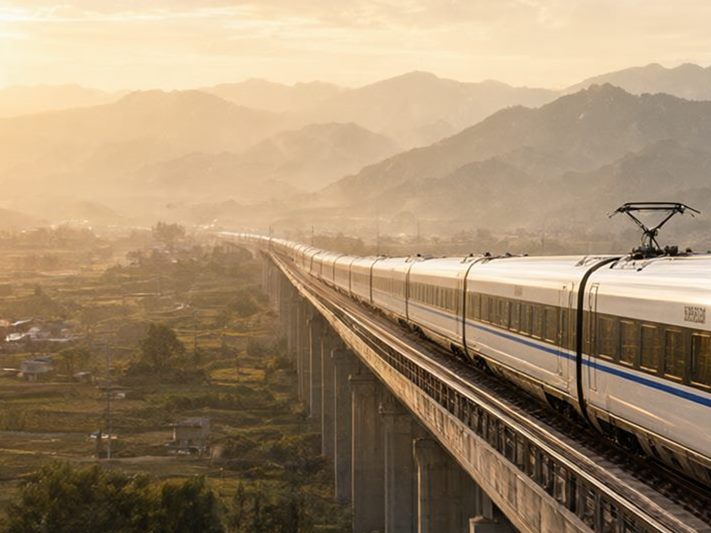
The kit, and where to find a toilet
Tissues, wet wipes, hand sanitiser, a small bag for used ones, and ¥5 in coins for the occasional paid toilet. A large handkerchief is useful as a door hook when there is no hook.
Men and women are marked 男 and 女, usually with a pictogram. The accessible cubicle is 无障碍. In an emergency, the nearest mall, metro station or chain coffee shop is your friend.
Do not flush wet wipes, even the ones that say flushable. The bin exists for a reason, and the reason is a pipe narrower than your wrist.

Questions travellers ask
- Do Chinese public toilets have toilet paper?
- Usually not. Some have a dispenser at the entrance, and hotels, malls, airports and high-speed trains provide it. Carry two tissue packs, which cost ¥1–2 at any convenience store, and hand sanitiser. Assume no paper and you will never be caught out.
- Can you flush toilet paper in China?
- No. Plumbing in many buildings cannot take it, and the bin beside the pan is there for used paper. This applies in hotels too, where the sign is often on the back of the door. Wet wipes always go in the bin, whatever the packet claims.