Chapter 01 — Orientation
Limestone towers, one river, a lot of bicycles
Guilin is a small city on a big river, sitting on a limestone plateau that was a shallow sea 300 million years ago. The peaks are what is left of it, dissolved into towers 100 to 200 metres high, and the city keeps several between its streets: Solitary Beauty Peak behind the old princely palace, Elephant Trunk Hill on the river bend, cave mouths at the foot of half the rest.
The city itself is a staging post. The good river is 30 km downstream, the boats leave from Mopanshan and Zhujiang piers between 9 and 11am, and they all finish at Yangshuo four and a half hours later. From Yangshuo, Xingping is 40 minutes upstream by local bus and the Yulong river is a half-hour bicycle ride west. Longji, the rice terraces, is 2.5 hours north of Guilin — the opposite direction, which is why it needs its own night.
The karst shapes the farming as much as the view. Villages sit on the flat valley floors and work rice in strips between the towers; the water table is high, the soil thin, and every field is a different shade in the same week. In April and May the river runs high and green and the peaks are half-erased by cloud; by December it runs low enough that the boats shorten the route.
Treat Guilin city as a hinge rather than a base: one night before the boat, one after the terraces. Yangshuo gets two nights, because the point of it is the hour before breakfast and the hour after the day-trippers leave, and both of those happen when you are already there.
Chapter 02 — Five days
Downriver, then uphill
Day 1
PM
The city, briefly
Walk the Two Rivers and Four Lakes circuit at dusk, when the pagodas are lit and the locals are out with speaker boxes. Elephant Trunk Hill has no entry fee any more, so the far bank path fills at sunset. Eat Guilin rice noodles for ¥10 with pickled beans and chilli, then sleep early: the boat bus leaves at 8.
Day 2
AM
The river, four and a half hours
A shuttle takes you to Mopanshan pier, 40 minutes south of town; boats leave between 9 and 11 and there is no later one. Sit on the upper deck on the left for the first hour, then move to the back rail between Yangdi and Xingping, where the peaks stack up and the water turns green. You dock at Yangshuo at about 14:00.
Day 3
AM
Bicycles and a raft
Hire bikes for ¥40 and ride west out of Yangshuo on the Yulong river path, 12 km of flat lane between fields and towers. Rafts run from Jinlong Bridge at ¥240 for two people, 90 minutes, poled rather than motored. Lunch in a village, back by 4, and be seated at the river theatre by 8 for the light show.
Day 4
AM
Xingping at 7am
Take the first bus upstream (40 minutes, ¥8) and walk the old street while the market is still a market. The twenty-yuan bend is ten minutes south along the river; the climb up Laozhai Hill takes 30 minutes and is the only view that improves on the bank. Cormorant fishermen pose on the rafts for ¥30–50 a photograph.
Day 5
AM
Terraces before the sun
Be on the viewpoint above Ping'an at 6:30, when the valley is still blue and the first mist sits in the bowl. Walk the stone lanes back down through the village, then take the 10:00 bus across to Dazhai, ride the cable car down and catch the 15:00 bus back to Guilin. The whole morning costs ¥80 in entry and a great many steps.
Chapter 03 — Six sights
Downstream, then uphill
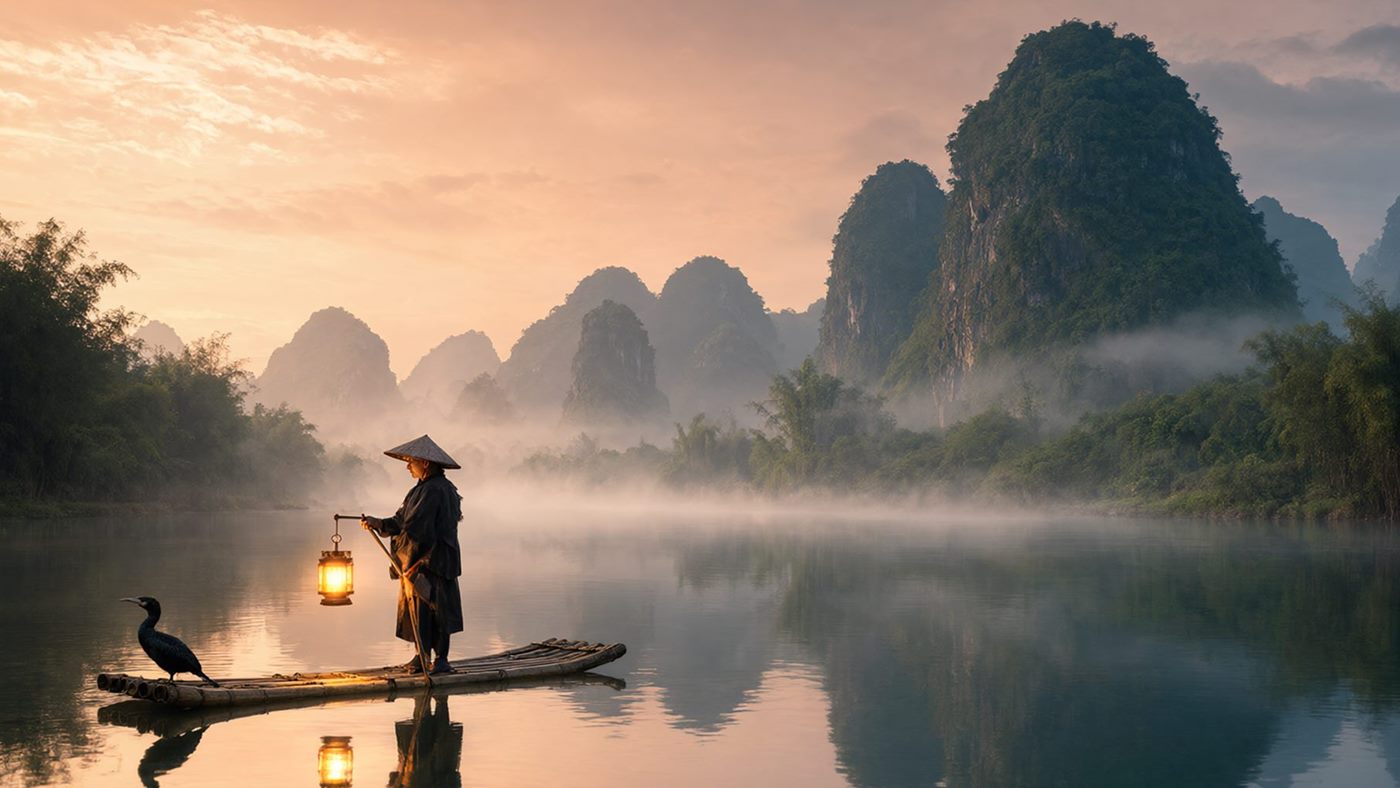
01 · The river
Li River, Guilin to Yangshuo 漓江
Eighty-three kilometres of river between limestone towers, with the best 20 km between Yangdi and Xingping. Boats are a slow convoy rather than a private cruise, and the ¥215 seat sees the same water as the ¥450 one; the difference is lunch and legroom. Book the morning departure, because the afternoon boats run into haze and the return coaches.
¥215–450depart 9–11am4.5 hone way
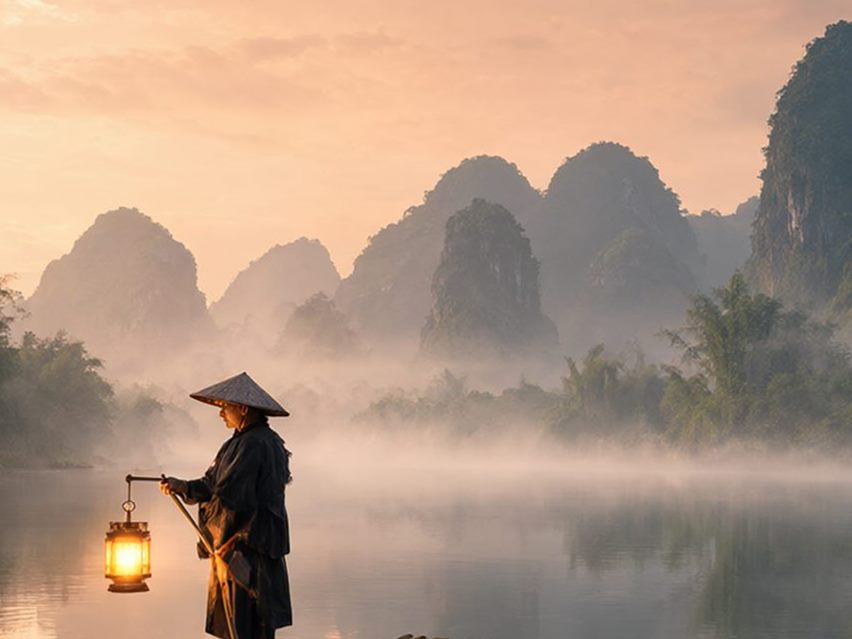
02 · The note
Xingping 兴坪
The bend printed on the twenty-yuan note is a ten-minute walk south of the village, and the note is held up against the view by every visitor in Guangxi. The fishermen now work for photographers rather than fish: ¥30–50 buys the pose, the lamp and the birds. Climb Laozhai Hill behind the town for the wide version.
freebus ¥8, 40 minbest 7–9am2–3 h
筏
03 · On the water
Yulong River rafts 遇龙河
A shallow tributary west of Yangshuo, too small for the big boats and better for it. Bamboo rafts carry two passengers each, ¥240 for the pair, 90 minutes from Jinlong Bridge, with a small drop at a weir that gets everyone's shoes wet. Cycle out, raft back, and skip West Street until after dark.
¥240 / raft8:00–17:3090 minbike ¥40
田
04 · Up north
Longji rice terraces 龙脊梯田
Terraces cut into the flanks of a 1,000-metre ridge by Zhuang and Yao villages over 700 years, in two clusters: Ping'an and Dazhai. The light is best at dawn, the water is in the paddies from mid-May, and the harvest turns the whole slope gold in the last week of September. Buses leave Guilin's Qintan station through the morning.
¥80bus 2.5 hcable ¥100one night
洞
05 · Underground
Reed Flute Cave 芦笛岩
Five hundred metres of limestone passage lit in magenta and lime, which is either magnificent or a 1980s disco depending on your tolerance. The formations are genuinely old and genuinely large; the lighting is not subtle. It is 20 minutes from the city centre and takes an hour, which makes it a decent wet-afternoon fallback.
¥908:00–17:301 hbus 3
象
06 · In town
Elephant Trunk Hill 象鼻山
The hill that gave Guilin its logo: a karst arch dipping its nose into the Li, with a moon-shaped hole punched through the top. The ticket was scrapped, so the riverside path is now free and busy at sunset. Twenty minutes is enough, and it is worth more as an evening walk than as a sight.
free7:00–22:0020 minsunset
The river decides
Everything here runs on water level. In flood — usually a handful of days in May and June — the cruise is suspended and the rafts come off the Yulong, sometimes with a few hours' notice. In December and January the river drops far enough that boats load at a different pier and skip the shallow upper stretch, which is not the stretch you came for.
The boat is one-way and there is no return service, so plan to stay in Yangshuo rather than coming back the same day. Luggage travels with you on the deck. Note also that Yangshuo's railway station is at Xingping, 27 km from Yangshuo town: the bus connection takes 40 minutes and surprises a lot of people at 7am.