Chapter 01 — Orientation
An oasis with one crossroads and 735 caves
The town is small enough to learn in an afternoon: six or seven streets around a single junction, a night market at the southern end of the spine, and a hotel strip along the road to the dunes. The airport and the railway station are both about 12 km east, which means the taxi into town costs less than the airport coffee.
The distances take the planning. Mogao is 25 km east, the Singing Sand Dunes begin 5 km south of the town centre, Yumen Pass is 90 km north-west, Yangguan 70 km south-west, and the Yadan badlands are 180 km west — three hours each way on gravel. That is why the west is done as a tour rather than a drive, and why the tours leave at 7am or come back at midnight.
The town exists because of the road. Han garrisons held it from 111 BCE, caravans split here to go north or south around the Taklamakan, and the caves were paid for by that traffic between the 4th and 14th centuries. When the sea routes took over, Dunhuang emptied, the sand filled the lower caves, and the dry air kept everything the sand did not bury.
Two nights is the minimum: one for Mogao, one for the dunes and the western forts. A third lets you take the full-day Yadan run and still eat dinner at eleven. Come in September or October, when the afternoons are 22°C and the light lasts until eight.
Chapter 02 — Four days
Caves, dunes, gravel
Day 1
PM
Night market, first night
Arrive, check in, and walk to the night market for 8pm, when the grills are lit and the whole town is in one street. Order donkey-meat yellow noodles (¥18), a plate of lamb skewers, and apricot juice served cold in a paper cup for ¥8. It is a tourist market and it is also where locals eat; both things are true.
Day 2
AM
Mogao, first shuttle
The A ticket starts with two films at the visitor centre, then a shuttle to the cliff. Take the 8:00 slot: groups of 25, one guide, eight caves chosen to spread the crowd, and no photographs inside any of them. The nine-storey façade of Cave 96 is the one you have seen. Four hours, back in town by two.
Day 3
AM
The west, all day
A 9:00 start for Yumen Pass, the Han wall of rammed earth beside it, and then the two-hour run to Yadan for sunset. It is 360 km of driving and about four hours actually standing up. Take water for the whole day; there is nothing to buy after the last service station at 11am.
Day 4
AM
Dunes at 6:30
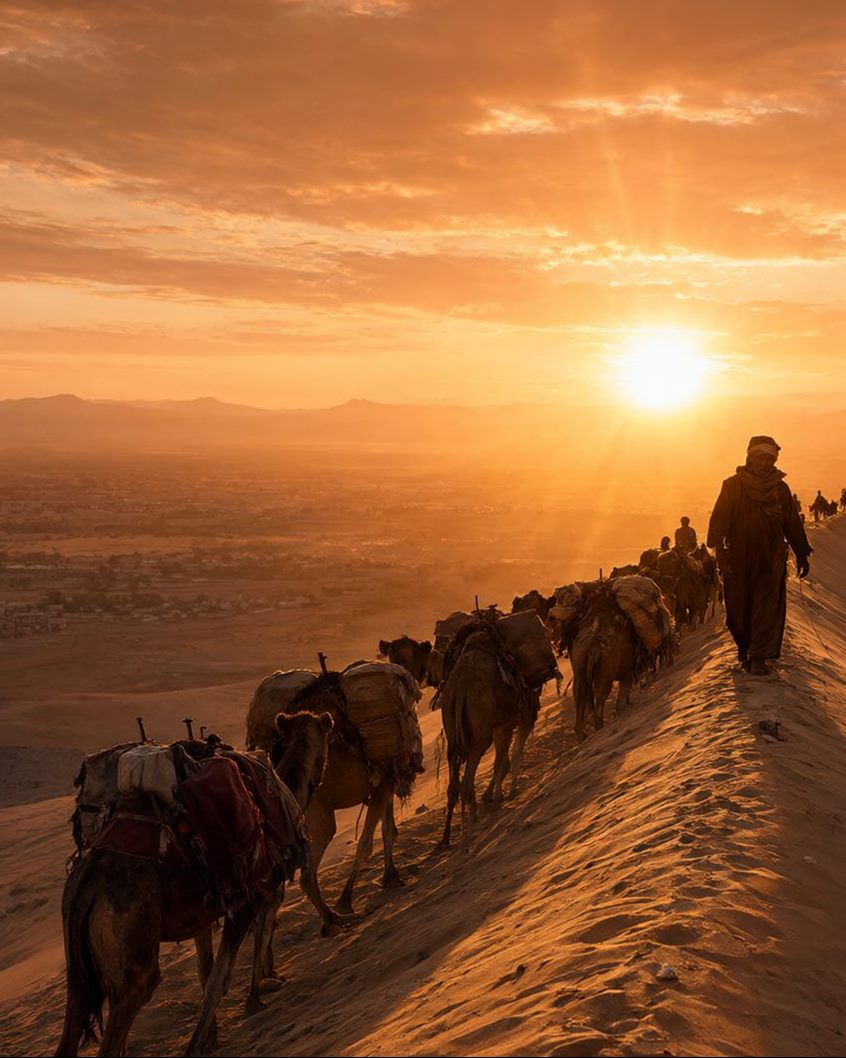
Enter the dunes at 6:30 for sunrise, when the sand is cold and the ridges throw shadows, and ride a camel at 7 rather than at 6pm. Climb the ridge above Crescent Lake for the view of the water in its bowl of sand, then leave by 10 before the heat. The ticket is valid three days, so a second evening costs nothing.
Chapter 03 — Six sights
Caves first, then sand
01 · Caves
Mogao Caves 莫高窟
Seven hundred and thirty-five caves cut into a gravel cliff, 492 of them painted, with 45,000 square metres of murals and 2,400 sculptures between the 4th and 14th centuries. You see eight on the A ticket with a guide who has the key to each door. Cave 17, where 50,000 documents were found in 1900, is barely three metres square.
¥2388:00–18:0025 km east4 h
沙
02 · Sand
Crescent Lake and the dunes 月牙泉
A spring in the shape of a crescent, held between two dunes 250 m high, 5 km south of town. It has been shrinking since the 1960s and is now topped up to keep it at depth; the pavilions beside it are rebuilt, the setting is not. Camels leave in trains of twenty at ¥100 a ride, which is a queue with a view.
¥110 / 3 days5:00–21:00camel ¥1002–3 h
雅
03 · Badlands
Yadan landforms 雅丹
A field of wind-carved clay ridges 180 km west, some 20 m high, aligned like a fleet under sail. The shuttle stops at four viewpoints and the last one is for sunset, which is the only time the shapes read properly. It is a long day for a strange place: three hours of gravel each way, and no shade anywhere on the route.
¥120 with bus180 kmsunset slotfull day
关
04 · Frontier
Yumen Pass 玉门关
A square of rammed earth 90 km north-west, once the last gate before the desert, with the Han wall running away from it in a line of crumbling ridges. There is not much to see and that is the point: a customs post at the edge of an empire, standing in gravel, with nothing behind it for 400 km. Forty minutes is enough.
¥408:00–18:0090 km1 h
夜
05 · Evening
Shazhou night market 沙洲夜市
One long street of grills, noodle stalls and dried fruit, opening around 7pm and thinning after midnight. The noodles are the local dish — thick, yellow, made with donkey meat and a starchy sauce — and the apricot juice is made from fruit grown 40 km east. Sit at the back where the tables are plastic and the prices are lower.
free7pm–1amnoodles ¥181–2 h
简
06 · Context
Dunhuang Museum 敦煌博物馆
The best hour you can spend before Mogao, because it explains the trade routes, the garrison and the manuscript hoard in a sequence a cave guide cannot. Han bamboo slips, Tang silk, and a reconstruction of the library cave as it was found. Free, closed Mondays, and small enough to finish before lunch.
free9:00–17:00closed Mon1.5 h
A ticket or B ticket
The A ticket (¥238) includes two films at the visitor centre, a shuttle to the cliff and eight caves with a guide; it is capped at 6,000 visitors a day and released 30 days ahead, which is why September dates disappear in July. The B ticket (¥100) is four caves, no films, sold on the day, and is the fallback for anyone who did not plan.
Whichever you hold, photography is banned inside every cave and the guards are serious about it. Bags go into lockers at the entrance, the caves stay at about 15°C all year, and the walk between them is unshaded. Book with the passport number of every visitor, and bring the passport itself to the gate.