Field notes · No. 12 · Xingping
By the ChinaTravel.fly field desk 6 min read Updated Nov 2026
- The note
- ¥20fifth series, in circulation since 2000
- From Yangshuo
- 45 minbus every 20 minutes, ¥8–10, 25 km upstream
- Laozhai Hill
- 30–40 minfree, unlit, steep, about 200 m above the river
- Raft to Nine Horse Hill
- ¥120–22050 minutes, four to a raft, life jackets supplied
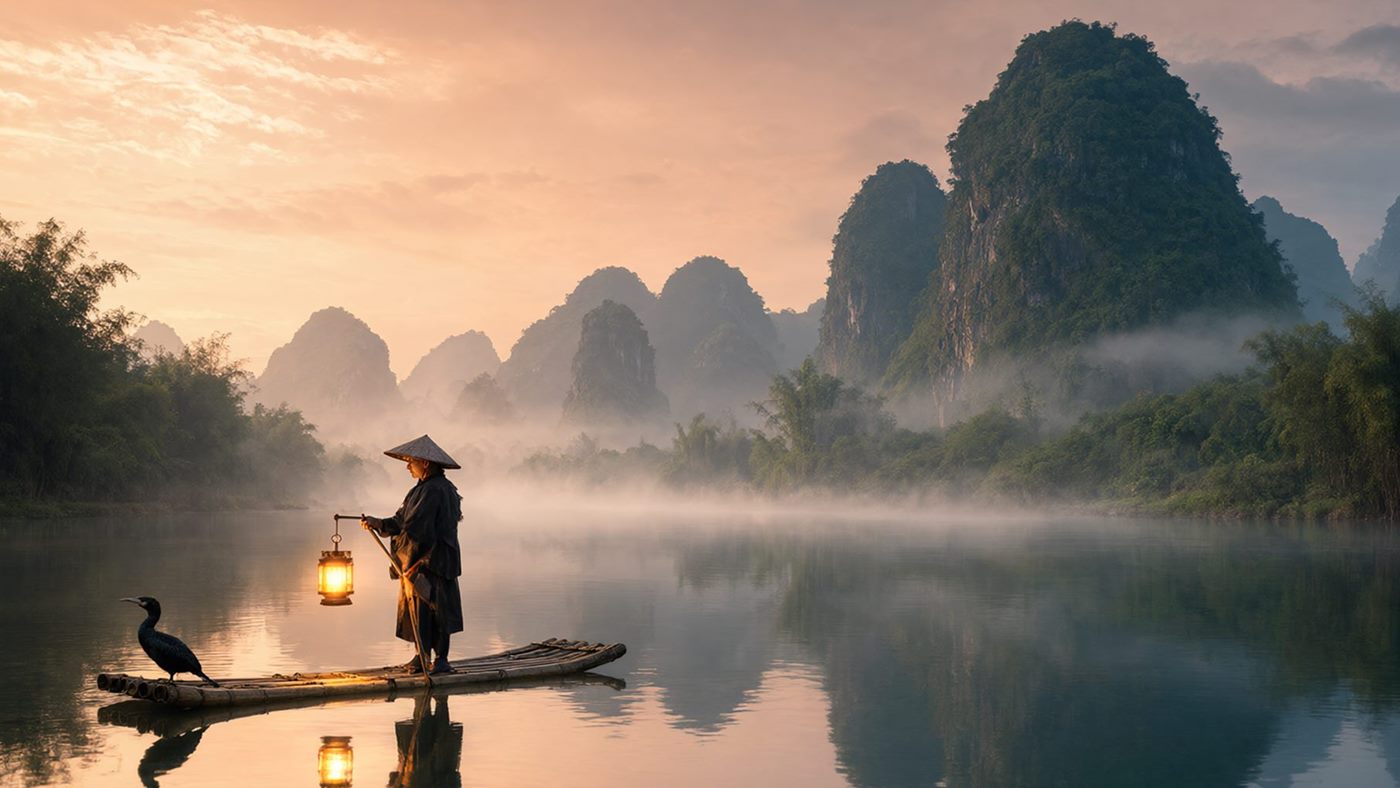
The back of a twenty-yuan note shows a river making a wide left-hand turn around a cluster of limestone towers, with a bamboo raft in the lower right and a sky engraved into a printable grey. It is not a composite. The bend exists, twenty-five kilometres upstream of Yangshuo, and the best place to look at it is a concrete platform at the end of a footpath, with a sign photographed so often the paint has gone.
How a place becomes a picture
The note was issued in 2000 and the view has been reproduced several billion times since, which does something odd to the original. You arrive knowing the composition, and it is correct. What an engraving cannot show is scale: the nearest peak is a twenty-minute walk away, the furthest four kilometres, and the whole thing is wider and lower than the note suggests.
Xingping itself is a river port that has been one for a very long time, with a single main street, a market hall, a few stone houses with wooden balconies, and a jetty where the rafts leave. It takes forty minutes on the bus from Yangshuo, which is why it is quieter, and ten minutes to walk from one end to the other, which is why people stay two nights instead of one.
Six twenty, and the water is still
We left the guesthouse at ten past six with the sky the colour of dishwater and walked downstream along the west bank, past a woman burning leaves. The path is paved, then dirt, then paved, and takes about fifteen minutes. At 6:35 there were four people on the platform: two tripods, one phone, and a man selling tea from a thermos for ¥5.
The light arrives from behind the eastern peaks rather than over them, so the first ten minutes are blue and the river is a mirror. Then the sun clears the ridge at about 6:50 in October and the water goes from grey to pewter to a colour no camera renders honestly. The mist sits in the channel and lifts from the surface upward, so the peaks appear to stand in a cloud poured at their feet.
The note is a promise that the view will be simple. The view is not simple; it is a weather system with a river running through it. Field desk · Xingping, Guangxi
The platform, and the queue that forms
Between 7:00 and 8:30 the platform is a pleasant place to be. By 9:15 the first big boats arrive from Yangshuo, four decks high, each carrying a hundred and fifty people who have been on the water since eight. A queue forms at the rail, a laminated twenty-yuan note is passed along it for the photograph, and a man with a megaphone explains the composition to people already taking it.
The cormorant boats are the other attraction. The birds are real, the fishermen are real, and the fishing is mostly a demonstration now: a ring at the neck, lamps for photographs rather than fish, and ¥20–50 a person for a pose, which everyone pays because the alternative is a photograph of an empty raft. It is honest work in a place photographed for forty years, and better than the alternative, which is no boats at all.

The other view, which costs a climb
Laozhai Hill rises directly behind the town and is free, unlit and steeper than it looks. The path starts near the jetty, switches back through scrub, and takes thirty to forty minutes. There are two small pavilions at the top, a certain amount of litter, and a view down onto the bend that makes the note's composition look timid. Sunrise here is good; sunset is better, because the river turns gold and the boats have gone.
Xianggong Hill, on the other side of the river and forty minutes away by car, is the paid version: ¥60, fifteen minutes up stone steps, a deck facing east over a different bend. It is the better sunrise shot and the worse experience, because at 6am in October there may be sixty tripods on three levels. Choose one. Doing both in a morning is how people end up hating a place this beautiful.
Doing it properly
Sleep in Xingping, not Yangshuo. The bus from Yangshuo does not start early enough to beat the light, and the town is cheap: ¥150–300 for a double with a river view.
Walk to the platform rather than taking a raft, which is ¥120–220 and puts you at water level, the wrong height for the note's composition. Save it for the afternoon, when the light is flat anyway.
Check the wind, not the cloud. A 15 km/h breeze kills the reflection by half past seven. November and early December give the clearest water and the fewest boats.
Whether it is worth the alarm
Yes, with one condition: you have to be there before the boats, and you have to accept that the mist may not come. On a clear, windy morning the bend is merely very good, and you will have seen it before, in your pocket. On a still morning after rain it is the reason people come to Guangxi. The difference is a forecast and forty minutes of sleep, and the gamble is worth taking once.
We stayed until twenty past seven, walked back for noodles, and were on the 9:40 bus while the first boat was still unloading. The note in my wallet looked flat and green and entirely correct, and I have not been able to look at it since without hearing that water.
Questions travellers ask
- Where exactly is the view on the ¥20 note?
- At Huangbu Shoal, on the Li River about fifteen minutes downstream of Xingping on the west bank, where a small platform has been built for the purpose. It is a signed footpath from the jetty and free to visit. Boats also stop there, but the composition is better from the bank.
- What time should you arrive for the mist?
- Be on the platform by 6:20 in October, 6:40 in November, or 7:00 in December. Sunrise is roughly 6:50, 7:05 and 7:20 in those months. The mist usually forms after rain and a clear night, and the first tour boats from Yangshuo arrive between 9:00 and 9:30.