Food · The eight cuisines
By the ChinaTravel.fly field desk 7 min read Updated Nov 2026
- Canon
- 8 cuisinesand about thirty traditions the list ignores
- Bill
- ¥50–90 ppmid-range restaurant, three dishes between two
- Grain line
- Qinling–Huaihewheat to the north, rice to the south
- Tea
- ¥5–10seat charge per person, refills free
The eight great cuisines — 八大菜系 — are a filing system, not a faith. Trade associations settled on the list in the 1980s to sort restaurant menus and state banquets, and it has been taught ever since as though the country eats by index card. Cantonese, Sichuan, Shandong, Jiangsu, Zhejiang, Fujian, Hunan and Anhui made the cut because each had a wealthy merchant class, a port or a salt monopoly. Xi'an, Yunnan, Xinjiang, Tibet, Dongbei and every breakfast in the country did not.
So use the eight as shorthand when you read a restaurant sign, and ignore them when you sit down. Four gradients explain more of what arrives on the table than any list of specialities.
What actually changes at the line
- The grain. North of the Qinling–Huaihe line it is wheat: hand-pulled noodles, steamed bread, dumplings, porridge to start. South of it, rice at every meal, including breakfast.
- The oil. Rape-seed in the west and southwest, which is why Sichuan food tastes faintly of mustard greens; peanut oil in the south; lard in the east until a generation ago.
- The chilli. Fresh and brutal in Hunan; dried, fried and numbing in Sichuan; pickled and sour in Guizhou; almost absent in Jiangsu and Zhejiang, where sugar does the work.
- The vinegar. Shanxi black vinegar is dark and strong enough to strip a pan; Zhenjiang vinegar in Jiangsu is softer and sweet; rice vinegar in Guangdong is a background note. Ask for 醋 and you get whatever the province considers normal.
China does not have a national cuisine. It has a grain line, a chilli gradient, a vinegar shelf, and four thousand years of arguments about which province cooks best. Field desk · somewhere between Xi'an and Chengdu
A working map, in five blocks
North. Beijing, Shandong, Shanxi, the north-east. Wheat, lamb, vinegar, strong salty flavours. Order dumplings, noodles with fried bean sauce, lamb skewers, and anything described as 家常, home-style. This is the easiest region to eat in badly, because the tourist versions are everywhere, and the easiest to eat in well, because the neighbourhood versions cost ¥15.
East. Jiangsu, Zhejiang, Shanghai. Sweet, braised, delicate, obsessed with river fish. Wuxi cooks with sugar the way Lyon cooks with butter, and a Shanghai red-cooked pork surprises visitors expecting soy and salt. Order soup dumplings, stir-fried greens, and a whole fish steamed with ginger. Rice arrives late and in small bowls.
South. Guangdong, Guangxi, Fujian. Steam, soup, rice noodles, and the best breakfast in the country. Dim sum in the morning, roast meat at noon, a rice-noodle soup at eleven at night.
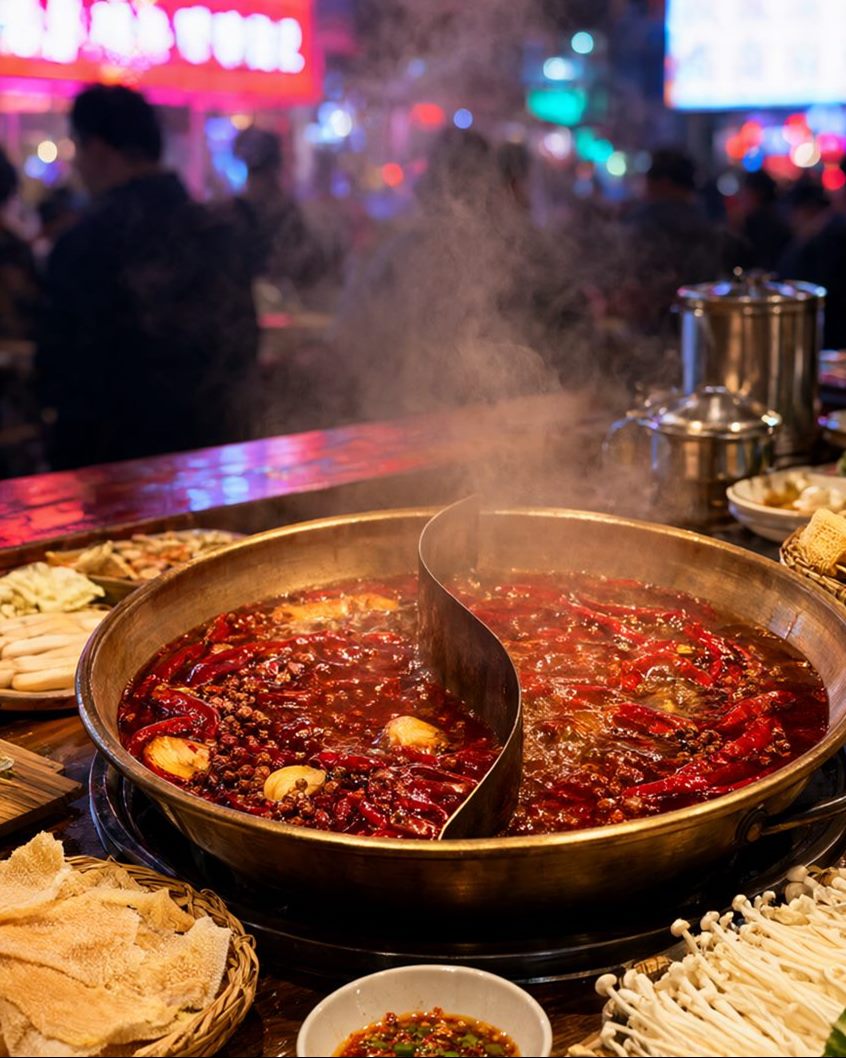
Southwest. Sichuan, Chongqing, Yunnan, Guizhou. Chilli, fermentation, pickles, wild mushrooms, and hotpot in several incompatible forms. Order mapo tofu, cold chicken in chilli oil, and rice noodles for breakfast in Kunming.
West. Gansu, Xinjiang, Qinghai, Tibet. Lamb, cumin, wheat, yoghurt, and tea with butter or salt. Order hand-pulled noodles with beef, cumin lamb, naan from a tandoor drum, and yak yoghurt. This region rewards a roadside stall over a restaurant.
How a meal actually arrives
Cold dishes come first, then meat, then vegetables, then soup and starch. Everything lands in the middle of the table and everyone reaches in; your own plate is a landing pad, not a portion. A table of four orders three dishes plus rice and will be full. There is no shame in leaving food, though there is mild shame in ordering badly.
Prices in a mid-range city restaurant in 2026: ¥18–38 for a vegetable, ¥38–68 for a meat dish, ¥8–15 for rice per head, tea at ¥5–10 a person. Two people eat well for ¥120–180. In Shanghai or a Beijing mall, add thirty per cent. Tipping does not exist.
Ordering without the language
Learn the structure of a dish name rather than the dish: 肉 is meat, 鸡 chicken, 鱼 fish, 牛 beef, 羊 lamb, 炒 stir-fried, 炸 fried, 汤 soup, 面 noodles, 饭 rice. You will not read the menu, but you can rule out the fish head.
Pointing works. So does the photo menu, which most restaurants have and which is more reliable than a translation app, because it shows the size of the plate.
不要辣 means no chilli and is ignored in about half the country, not out of rudeness but because the kitchen cannot imagine the dish without it. 少辣, a little, is obeyed more often. Order a plain steamed vegetable as insurance.
Where to start, province by province
Pick two regions and eat properly rather than five and eat photographically. Chengdu for the chilli end of the spectrum; Guangzhou for steam and soup, where a ¥70 breakfast will ruin other breakfasts for you; Xi'an for wheat, where the whole street is a single carbohydrate argument. Beijing is duck and dumplings and not much else at the cheap end. Shanghai is the sweet east, best at lunch, when the neighbourhood canteens are open and the prices are half the evening's.
The one thing worth knowing before any of it: Chinese food is regional to a degree Europeans find hard to credit. A cook from Harbin and a cook from Guangzhou share a written language, a wok, and almost nothing else. Ordering the same dish in both cities produces two meals that share a name and a colour and nothing more. That is not inconsistency. That is the point.
Questions travellers ask
- Are the eight cuisines actually a real thing?
- They are a real shorthand, formalised in the 1980s, but they are a restaurant trade classification rather than an anthropology. Whole provinces with distinctive food — Yunnan, Shaanxi, Xinjiang, Tibet — sit outside the list. Use the eight to read menus, then eat by region and season instead.
- How much should a normal restaurant meal cost in China?
- In a mid-range city restaurant, ¥50–90 a head including tea, with shared dishes. Two people typically order three dishes and pay ¥120–180. Add thirty per cent in Shanghai or Beijing malls, subtract it in provincial towns. Tipping is not expected anywhere and often causes confusion.