Food · Street food
By the ChinaTravel.fly field desk 7 min read Updated Nov 2026
- Skewer
- ¥3–10meat, vegetable, or something you did not identify
- Bowl of noodles
- ¥12–18sit-down stall, no menu in English
- Fruit cup
- ¥8–15peeled in front of you, or not at all
- Peak hour
- 22:00when the best stalls have their longest queue
Every city in China has a street that smells of cumin and hot oil after dark, and every guidebook tells you to be careful. Be specific instead. The risks are real but narrow, and they are almost all about time and temperature rather than nationality. A stall that cooks one thing, fast, over a visible flame, for a queue of people who live upstairs, is safer than most restaurants with a laminated menu.
The ten-second read
Stand back and look at four things before you join a queue.
- Turnover. Is the food moving? A stall selling 300 skewers an hour cannot hold anything long enough to spoil. A tray of fried things under a lamp in warm air is the opposite.
- The flame. You want to see it: a wok burner, a charcoal grill, a vat at a rolling boil. If the cooking happens behind a curtain, you cannot read the kitchen.
- The queue. Locals, not tourists. Ten people waiting at 11pm on a Tuesday is the strongest hygiene certificate in the country.
- The hands. One hand for money, one for food, is the standard. A glove that handles cash and then dumplings is worse than a clean hand.
Two more: the oil in a fryer should be amber, not black, and busy enough to be replaced during the evening. And the menu should be short. A stall doing one dish does it properly; a stall doing twenty is reheating nineteen.
What ¥10 should buy
| Item | Fair price, 2026 | Watch for |
|---|---|---|
| Meat skewers, 串 | ¥3–10 each | priced per skewer, not by weight |
| Roujiamo | ¥10–18 | bread crisped to order |
| Bowl of noodles | ¥12–18 | broth at a boil, greens added last |
| Stinky tofu, 臭豆腐 | ¥10–15 | fried to order, not held |
| Grilled squid | ¥15–25 | whole, on a stick, brushed at the grill |
| Fruit cup | ¥8–15 | peeled in front of you |
| Soy milk, 豆浆 | ¥3–5 | hot, from a urn, sweet or savoury |
Prices are posted at any legitimate stall, usually on a board or a sticker. If there is no price, ask before ordering, and if the answer is vague, walk. The classic overcharge is by weight: a fruit stall pricing at ¥8 per 50 g is charging ¥80 a jin, four times the supermarket. The other is the tourist strip, where a scorpion skewer costs ¥25 and exists only to be photographed.
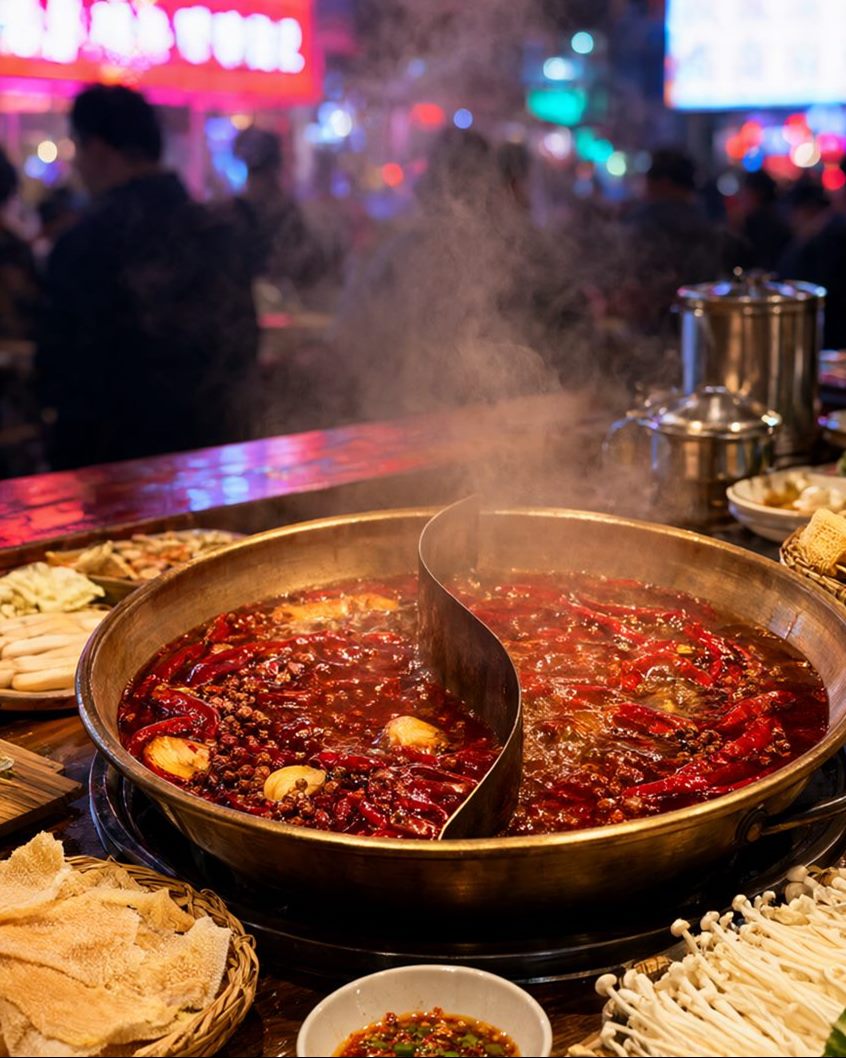
Street food is not a gamble, it is a reading exercise. The stall tells you everything in the first ten seconds, if you look before you order. Field desk · a night market, Chengdu
What to skip
Pre-cut fruit, sitting in the open, sold from a cart with no shade. Cold dishes dressed in advance and held in a tray. Anything raw: salads, herbs, the uncooked vegetables that come with a bowl of noodles, usually fine but the first thing to go. Ice in a drink from a bucket, unless the stall is a shop with a machine. Mayonnaise-based things in summer. And the buffet trays at scenic-area canteens, which hold food at 45°C for hours, the exact temperature bacteria enjoy most.
None of this is exotic. It is the same list you would apply in Naples or Bangkok. What is different is the volume: a Chinese night market has 200 stalls, so the odds of finding a bad one are high and the odds of finding a brilliant one are higher.
Stomach management
Most visitors have one bad day in the first week, usually not from the street but from a change in oil, water and chilli. It passes in 24–48 hours. Carry oral rehydration salts, ¥5 at any pharmacy, and loperamide for a travel day. Wash your hands or use sanitiser before eating, and do not drink tap water anywhere in the country, including hotels that tell you the kettle is for tea.
Eat yoghurt if you like it; the supermarket kind is cheap and does no harm. Do not spend the first three days at the most aggressive end of the chilli scale and then blame the street. A bowl of congee for breakfast the day after a night market resets the whole system.
The four stalls worth finding
Breakfast: a steam cabinet of baozi and a urn of soy milk, on a residential corner, from 6:30 to 9:00. The queue is people going to work and it moves in ninety seconds.
Night market: the stall with the longest local queue and the shortest menu. In Chengdu that is skewers in a chilli broth; in Xi'an, a bread oven; in Harbin, a charcoal grill in −20°C, which is its own refrigeration.
Station forecourts: cheaper and better than the train buffet, and the noodles are made in front of you. Allow twenty minutes.
Never the strip beside the main tourist sight. Walk two streets back and the price halves and the queue becomes local.
The honest summary
Street food in China is the best value in the country and one of the great pleasures of travelling here. It is also a market, with the same mix of skill, laziness and sharp practice as any market. Read the stall, pay the posted price, eat what is hot, and skip what has been waiting. That is the entire method, and it will hold up from a Harbin winter market to a Guangxi roadside at midnight.
Questions travellers ask
- Is Chinese street food safe for foreigners?
- Generally yes, if you choose by turnover. Pick stalls with a visible flame, a short menu, posted prices and a queue of local customers, and avoid pre-cut fruit, cold held dishes and ice from a bucket. Expect one unsettled day in the first week from the change in oil and chilli; it usually passes within 48 hours.
- How much should street food cost in China?
- A meat skewer is ¥3–10, roujiamo ¥10–18, a bowl of noodles ¥12–18, a fruit cup ¥8–15. A full night-market dinner for two lands at ¥60–100. Anything on a tourist strip costs two to four times that, and fruit priced by 50 g rather than by jin is the most common overcharge.