Field guide · Sichuan hotpot
By the ChinaTravel.fly field desk 6 min read Updated Nov 2026
- Cost
- ¥70–130per person, before beer
- Pot base
- ¥30–68paid once, for the table
- Dip
- ¥5–8per person, mixed by you
- Tripe
- 8–10 secseven up, eight down
- Time at table
- 2–3 hnobody is turned over
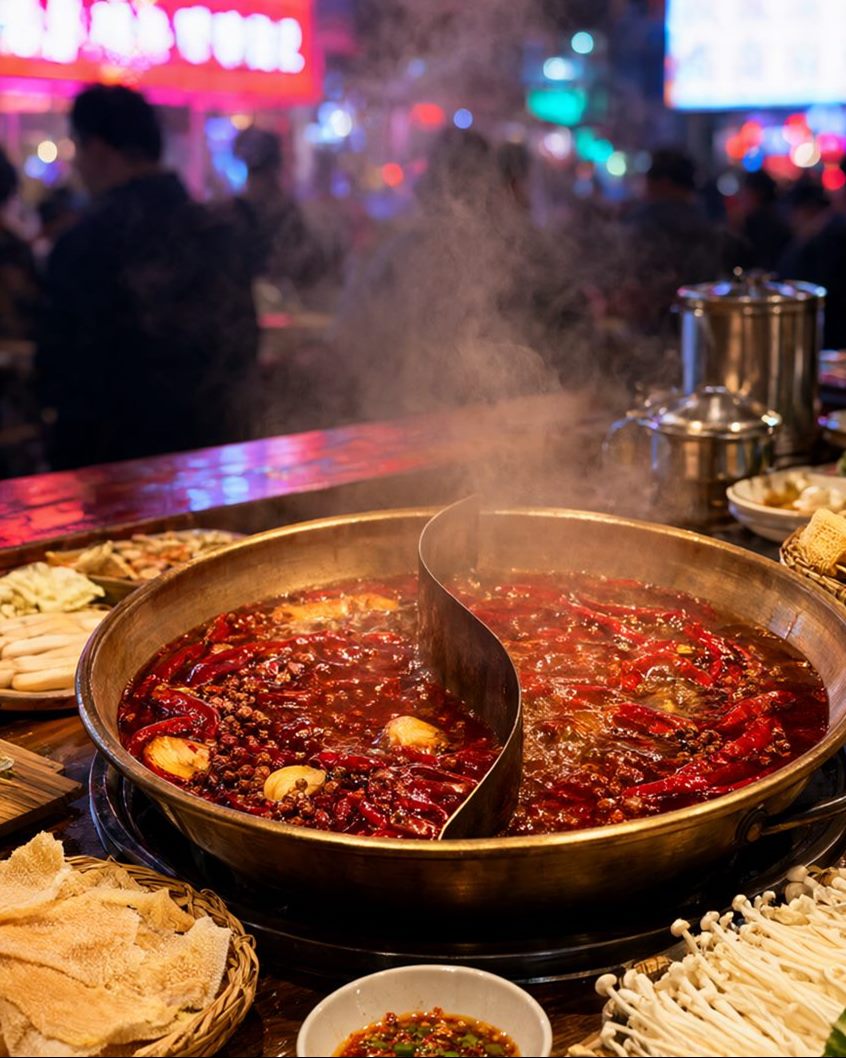
Hotpot is the most social meal in China and the least forgiving to order badly. The pot arrives already boiling, the broth is red to the point of opacity, and everything else — tripe, goose intestine, brain, potato — is timed in seconds. There is no chef to blame and no menu that explains itself. This is how to run the table.
The good news is that the format is forgiving. You order in rounds, cook what you like, and stop when you are full. The bill is split or one person pays; nobody itemises. And the meal is designed to last, because the point is the sitting rather than the food.
Chengdu or Chongqing
Chongqing hotpot is beef tallow: dark, dense, heavily numbing, with almost no dip tradition beyond oil and garlic, and often served in a nine-square grid so different parts of the pot cook at different rates. Chengdu hotpot uses rapeseed oil, is lighter and more aromatic, and leans on the sesame-oil dip. Both call themselves Sichuan food and both will argue about it.
For a first hotpot, eat in Chengdu. The broths are more forgiving, the split pot is standard rather than eccentric, and the waiters are used to explaining things. Chongqing is the stronger experience once you know what you are doing.
Choosing a broth
- 牛油红汤, beef tallow. The classic. Heavy, red, numbing, and the best match for offal. Ask for this if you want the real thing.
- 清油红汤, rapeseed oil. Lighter, sharper, easier on the stomach and the laundry. The Chengdu default.
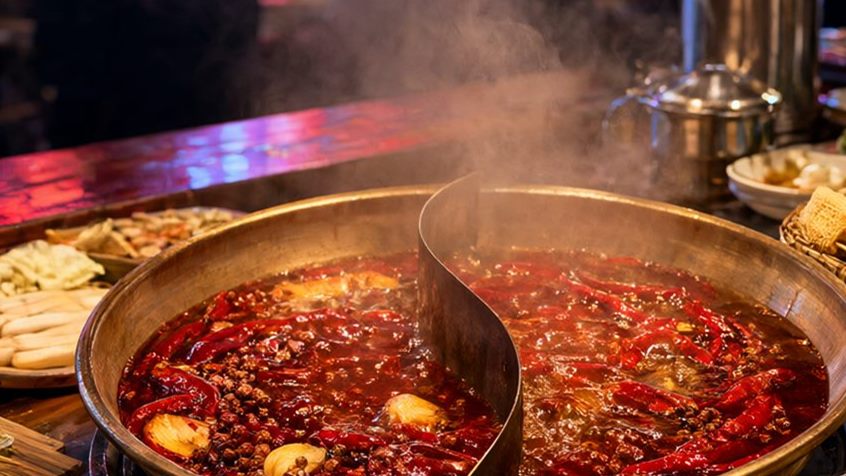
- 鸳鸯锅, the split pot. Half red, half white. No shame in it, and half the table will use both.
- 番茄 or 菌汤, tomato or mushroom. The white side. Good for children, good for the heat-averse, good for a break at hour two.
- 九宫格, the grid pot. Nine compartments at different temperatures. Centre for quick dips, corners for long braises.
Spice levels are not calibrated for visitors. 微辣 is not mild to most Europeans; it is what a Sichuanese person orders when their mother is visiting. Ask for 微微辣, or take the split pot and treat the white side as a fire exit. 麻 is the numbing sensation from Sichuan pepper and it is a separate dial from 辣, the chilli heat.
The dip is not what you think
There is no peanut sauce. 油碟 is sesame oil, raw garlic, coriander, a little vinegar and a spoon of oyster sauce, mixed by you at the table from the components the waiter brings. Two parts oil, one part garlic, coriander to taste. The oil cools the food and carries the aromatics; without it, the chilli sticks to your mouth and stays there.
干碟 is the dry version — chilli powder, cumin, crushed peanut and salt — and it is what you use for brain, kidney and anything with a soft texture. Order one of each and use them for different things.
The order that works
| Item | Time in the pot | Note |
|---|---|---|
| 毛肚, beef tripe | 8–10 sec | Seven up, eight down. It should still crunch. |
| 鸭肠, goose intestine | 10–15 sec | Until it curls. Any longer and it is rubber. |
| 黄喉, aorta | 30–60 sec | Crunchy, not soft. A test of the kitchen. |
| 腰片, kidney | 20–30 sec | Scored, and better in the dry dip. |
| 肥牛, beef roll | 10–15 sec | One dip, no stirring, or it shreds. |
| 虾滑, prawn paste | 3 min | Spoon it in as balls. Floats when done. |
| 脑花, brain | 12–15 min | In a basket, in a corner, away from the current. |
| 鸭血, duck blood | 5 min | Cubes. Ready when they darken. |
| 藕片, lotus root | 2–3 min | Still crunchy; 4 minutes is mush. |
| 土豆, potato | 3–4 min | Dissolves if forgotten. Order late. |
Start with the offal, because the broth is cleanest and hottest. Then meat, then vegetables, then noodles or potato. The 酥肉 — fried pork strips — arrives ready to eat, and is also very good dipped for ten seconds. Order two plates; one will be eaten before the pot boils.
In Sichuan the pot is not a cooking method. It is a conversation with a timer, and whoever knows when to take the tripe out is running the table. Field desk · Jinjiang, Chengdu
Etiquette, briefly
- Do not put something in and walk away. The pot is shared, and a forgotten potato ruins the broth for everyone.
- Use the basket. 漏勺 for small things, and do not fish through another person's corner of the grid.
- Ask for more broth. It is free. A pot that has reduced to sludge by hour two is your own fault.
- Order in rounds. Two or three plates at a time. The table fills up, the food goes cold, and nothing is improved.
- Aprons are provided. Wear one. The oil does not come out of a white shirt, ever.
Price, payment and the aftermath
The base is ¥30–68, the dip ¥5–8, meat plates ¥18–48, vegetables ¥8–18, beer ¥8–15, and a bottle of the sweet nut milk that everyone drinks with it is ¥8–12. All in, ¥70–130 a head at a neighbourhood place, ¥200 or more at a famous one with a two-hour queue. Pay by QR at the table; tipping does not exist.
Afterwards: your clothes will smell for two days, the restaurant may hand you a plastic bag for your coat, and the iced jelly dessert — 冰粉, ¥8–12 — is not optional if you have eaten the red side. Do not schedule anything ambitious for the following morning. The Sichuanese have a word for the condition and it is not complimentary.
One last thing: the pot is usually the cheapest part of the night and the sitting is the expensive one. Nobody will hurry you out, the tea is free, and the table next to you will be louder at midnight than it was at eight. That is the meal working as designed.
Questions travellers ask
- How much does Sichuan hotpot cost per person?
- ¥70–130 at a normal neighbourhood restaurant, including the ¥30–68 pot base, a ¥5–8 dip, three or four plates of meat and vegetables, and a beer. Famous places with queues run to ¥200 or more. The base is shared, so groups of four eat more cheaply than couples.
- What is the mildest broth at a Sichuan hotpot?
- Order the 鸳鸯锅, the split pot, and eat from the white side: tomato, mushroom or plain bone broth. If you want the red side, ask for 微微辣 rather than 微辣, which is still hot. The sesame-oil dip also cools the food considerably.
- How long do you cook tripe in hotpot?
- Eight to ten seconds, which is why the phrase is seven up, eight down: lift and dip repeatedly rather than leaving it in. Goose intestine takes ten to fifteen seconds until it curls, aorta thirty to sixty. Anything longer turns them to rubber, and the pot will not forgive you.