A lift in Chongqing can open onto a street. The city climbs a peninsula between the Yangtze and the Jialing, and the roads stack in layers, so a building's back door on the 22nd floor is another building's front door at river level. The monorail runs through a block of flats. The hotpot is worth the queue.
重庆 ChóngqìngChongqing Municipality · Southwest ChinaIdeal 3–4 daysWindow Mar – Apr & Oct – Nov
Population
32 millionmunicipality; about 10 million in the urban core
Metro
12 lines¥2–10; Line 2 is the monorail
Hotpot
¥80–150per person, before the beer
Yangtze cruise
4 daysChaotianmen to Yichang, ¥1,500–4,000
Airport
CKG20 km; metro Line 10, ¥8, 45 min
Chapter 01 — Orientation
A city with no ground floor
Chongqing's centre occupies the Yuzhong peninsula, a ridge of streets between the Yangtze to the south and the Jialing to the north. Jiefangbei is the commercial heart, a pedestrian square ringed by towers and malls; Chaotianmen, at the tip, is where the two rivers meet and the cruise boats dock. Across the water, Nan'an climbs its own hill and gives you the skyline view back towards the lights.
Distances are deceptive because they are vertical. A 400-metre walk on the map can mean eight flights of stairs, and the metro is often the quickest way between two points that look adjacent. Line 2 is the monorail and the useful one for sightseeing: it runs along the Jialing, through Liziba station inside a residential block, and on to the zoo. Taxis are cheap and plentiful; the drivers know which level of the hill you mean better than your map does.
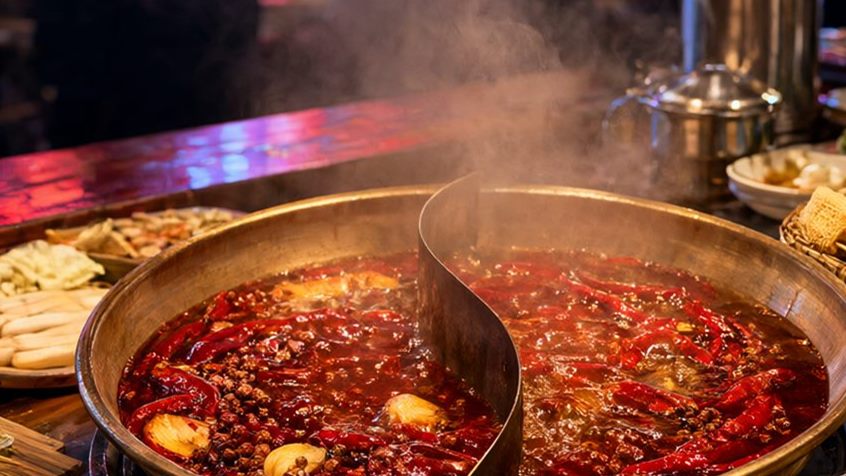
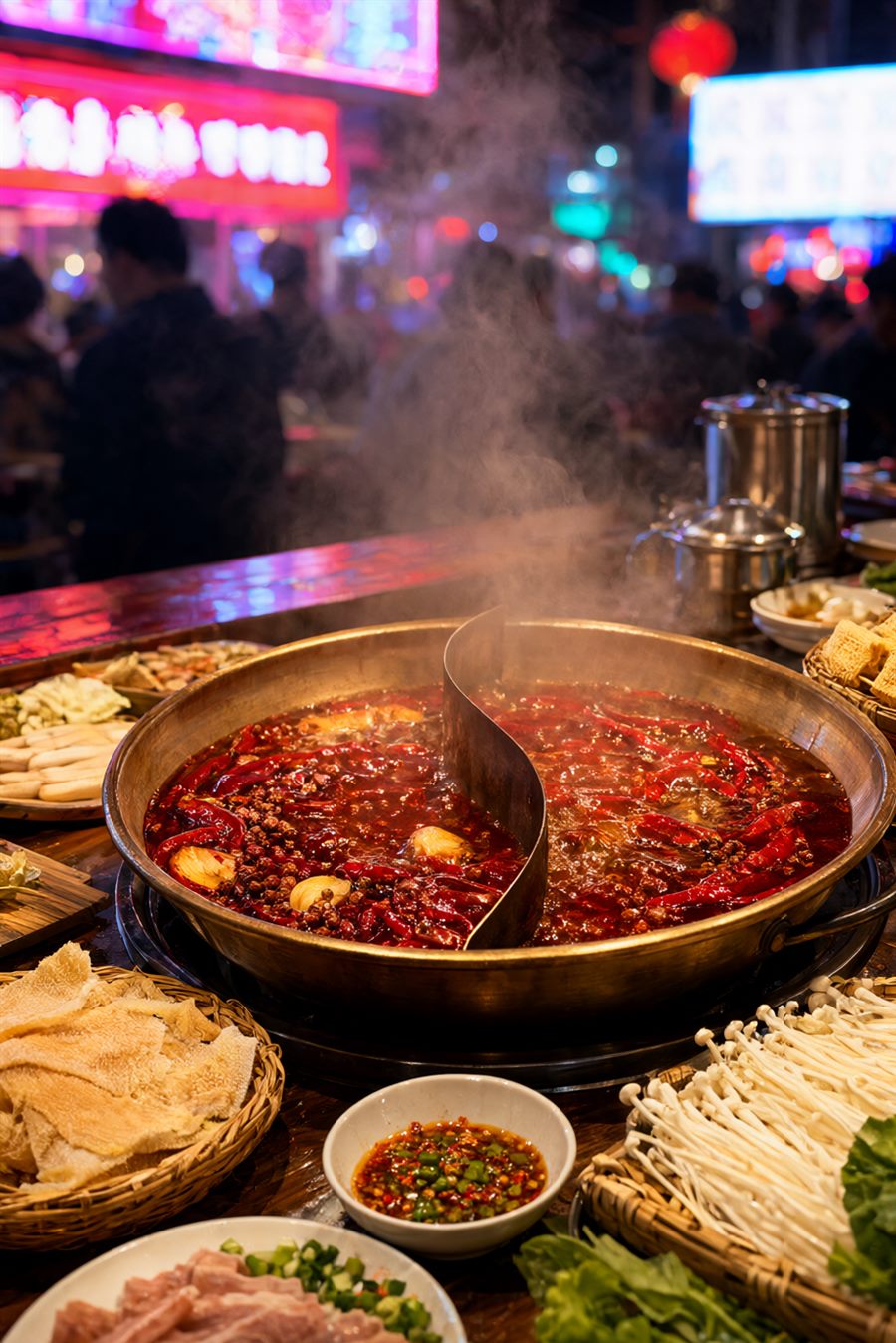
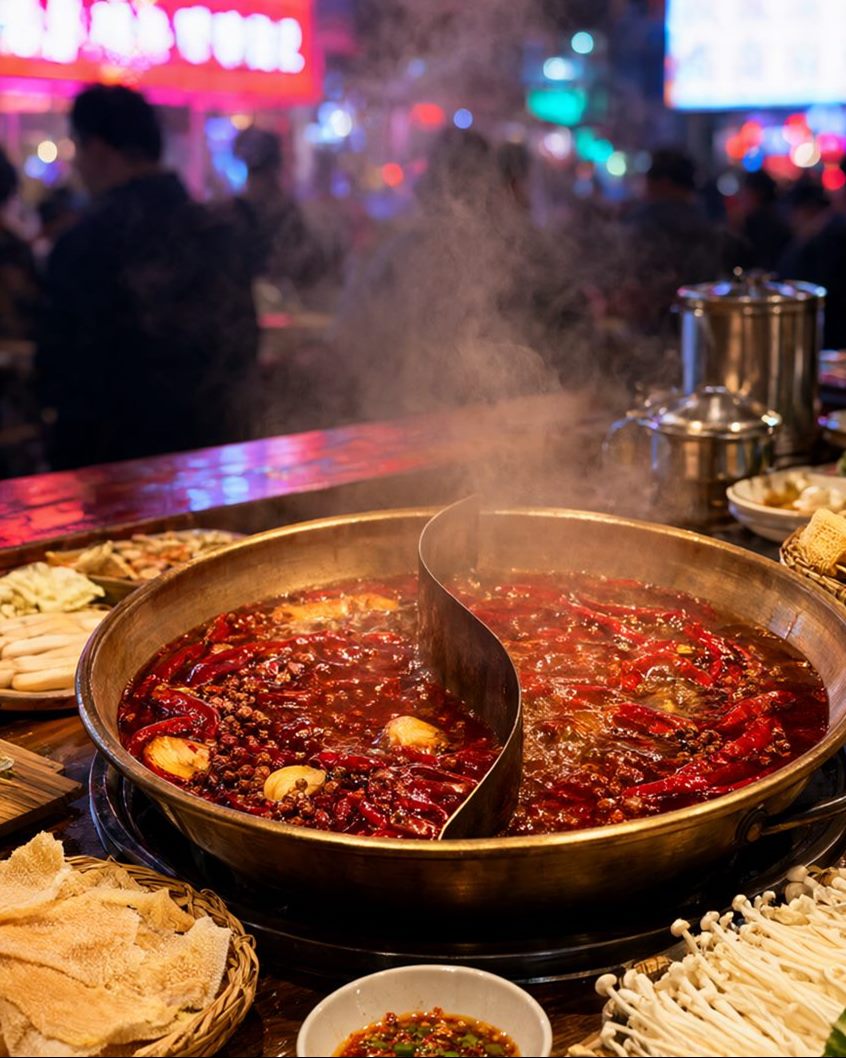
The city's signature dish came from the river docks, where labourers cooked cheap offal in a pot of beef fat, chilli and Sichuan pepper. That is still the formula: a divided pot, a tallow broth that sets as it cools, and a dip of sesame oil and garlic to cool the burn. Air conditioning and fog used to be the city's two seasonal moods; now it is glass towers and a night economy that runs until two.
Give Chongqing three days and stay near Jiefangbei, where the metro, the food and the river are all within reach. Four days adds the Dazu rock carvings, two hours west by bus. A Yangtze cruise adds another four days downstream, which is a different trip and should be booked as one.
Dinner, after darkTallow, chilli, pepperThe full table
Chapter 02 — Four days
Four days between the rivers
Day 1 PM
Jiefangbei, then Hongyadong
Check in, walk the Jiefangbei square and take the escalators down towards the Jialing. Hongyadong is best at 19:30, when the timber facade is lit and the crowd on Qiansimen Bridge is photographing it. Eat hotpot afterwards, somewhere with a queue and plastic stools; the oil dip and the tripe are the test of whether you have understood the city.
Day 2 AM
The monorail and the old town
Ride Line 2 from Linjiangmen, at the edge of Jiefangbei, to Liziba and stand at the front of the train as it enters the building. Get out, watch a few trains come through from street level, then take the monorail on to Eling Park for the view over the peninsula. In the afternoon, Ciqikou's old streets are 30 minutes away on Line 1 and best after 16:00, when the day trippers thin.
Day 3 AM
Rivers, cable car and museum
Start at the Three Gorges Museum on the hill above the Great Hall of the People, which explains the river, the dam and the paintings found in the caves. Then walk down to the Yangtze cable car and cross to Nan'an for the old street and the view back. In the evening, take a river boat if you want the skyline from the water, or save the money and watch it from the Nan'an bank.
Day 4 AM
Dazu, or the boat downstream
Dazu is two hours west by bus and holds some of the finest Buddhist rock carvings in China, cut into sandstone cliffs between the ninth and thirteenth centuries. The Baodingshan site alone takes two hours and is worth the day. If you are joining a cruise instead, board at Chaotianmen in the evening; the boat sails overnight and you wake up in the gorges.
Chapter 03 — Six sights
What is worth the stairs
崖
01 · The cliff
Hongyadong 洪崖洞
An 11-storey timber complex pinned to the cliff above the Jialing, built in the 2000s in a style that pretends to be older. It works best from a distance: the yellow lights come on at dusk and the whole stack reflects in the river. Inside is a vertical market of snack stalls and souvenir shops, hot, crowded and skippable. Photograph it from Qiansimen Bridge instead.
freelights after 19:0011 storeys1–2 h
轨
02 · The train
Liziba station 李子坝
Line 2 passes through the sixth to eighth floors of a 19-storey residential block, a piece of engineering that has become the city's most photographed commute. The station is ordinary; the sight is the train appearing out of a building and disappearing into the next hillside. Ride one stop in each direction, then stand on the pavement below and wait three minutes for the next one.
¥2–4every 3–5 minLine 230 min
索
03 · The crossing
Yangtze cable car 长江索道
A gondola that crosses the Yangtze in about five minutes, from the Yuzhong side to Shangxinjie in Nan'an. It was built for commuters in 1987 and is now mostly a tourist ride, with queues to match. Go early or late, buy a single ticket rather than a return, and walk back along the Nan'an bank for the view of the peninsula that makes the crossing worthwhile.
¥30 single7:30–22:305 min crossing30 min
瓷
04 · The old town
Ciqikou 磁器口
A former porcelain port on the Jialing, now a preserved street of tea houses, temples and snack stalls. It is unashamedly a tourist set piece, but the side lanes still have residents, and the tea houses on the upper street are calm once you are past the main drag. Come late afternoon, eat a bowl of douhua, and take the metro back before the evening rush.
free9:00–22:0030 min by metro2 h
05 · The table
Hotpot, properly 火锅
Chongqing hotpot is beef tallow, dried chilli and Sichuan pepper, boiled hard and eaten with a bowl of sesame oil and raw garlic. The nine-grid pot is not decorative: the centre boils hardest for quick things, the corners are gentler for potato and lotus root. Order tripe, duck intestine, luncheon meat and a plate of greens, and accept that the broth is for cooking, not drinking.
¥80–150 pp18:00–02:00nine-grid2 h
船
06 · The departure
Chaotianmen docks 朝天门
The point where the brown Yangtze meets the greener Jialing, and the place to watch the cruise boats load. Downstream cruises to Yichang take four days and three nights through the Three Gorges; upstream takes five. Cabins run from shared to suite, and the price includes meals but not the optional shore excursions. Book two to four weeks ahead in spring and autumn.
cruise ¥1,500–4,0004 days downstreamboard 18:00book 2–4 weeks
How to order the nine-grid
The pot arrives divided into nine squares, all filled with the same red broth, but the heat is uneven: the centre is the hottest, the corners the mildest. Start with the centre for tripe, which needs about fifteen seconds, and duck intestine, which needs eight to ten. Potato, lotus root and tofu skin go in the corners and stay there until you remember them.
The dip is sesame oil, garlic and coriander, sometimes with vinegar; it cools the chilli rather than adding to it. If the heat is too much, ask for yuanyang, a split pot with a mild bone broth on one side, and do not apologise. Drink soy milk or sour plum juice, not iced water, and expect the bill to be lower than the number of plates suggests.
Questions travellers ask
How many days do you need in Chongqing?
Three days covers Hongyadong, the Liziba monorail, Ciqikou, the cable car and a proper hotpot dinner at a comfortable pace. Add a fourth day for the Dazu rock carvings, two hours west by bus. Add four more if you are taking a Yangtze cruise to Yichang, which is a separate trip and should be planned as one.
Is the Liziba monorail worth seeing?
Yes, if you are already using Line 2. The train passes through the sixth to eighth floors of a residential block, and the stop is a 20-minute ride from Jiefangbei. Ride one stop through the building, then watch from street level for ten minutes. It is a curiosity rather than a day's outing, so pair it with Eling Park.
Where do Yangtze cruises leave from?
Most downstream cruises leave from the Chaotianmen docks at the tip of the Yuzhong peninsula, with some newer ships using Guoyuan port further north. Downstream to Yichang takes four days and three nights; upstream takes five. Fares run from about ¥1,500 to ¥4,000 per person and include meals, but not all shore excursions.