Field notes · No. 40 · Chongqing
By the ChinaTravel.fly field desk 6 min read Updated Nov 2026
- Metro
- ¥2–7Line 2 passes through a block at Liziba
- Climb
- 40 m/kmallow for it when you read a walking distance
- Fog season
- Nov–Febriver fog arrives late afternoon, lifts by eight
- Cable car
- ¥20one way over the Yangtze, ten minutes
Ask for an address in Chongqing and you will get a street, a building, a floor and a door number, in that order, and the floor is not a detail. A restaurant can be on the eleventh floor and still have a pavement outside it, because the building has entrances at four different street heights. Nothing here is lying to you. The vertical axis is simply missing from the drawing.
Which floor the street is on
The rule that makes the city navigable is that street level changes with the hill, and the building follows it. In Jiefangbei your booking may say level one while the actual entrance is on the eleventh floor of the same tower, reached by a lift from a road behind the block. Locals do not think in floors. They think in landmarks and in upper and lower, and they will tell you to take the lift to the eighth and walk out onto the road.
This is why a 600-metre walk on a map can mean a 40-metre climb, three flights of public stairs and a footbridge over a road. It is also why the city has so many escalators in public use: some are pavements with a motor. Hongyadong is the famous example, eleven storeys of stilted building with a road at the top and a river at the bottom, and people enter it from both ends without ever agreeing on which is the ground floor.
The monorail as a public lift
Line 2 runs along the south bank of the Jialing and then does something no metro should: at Liziba it passes through a residential block, entering one side at the eighth floor and leaving the other. The train is not a stunt. It is how people get to work, it runs every few minutes, and the viewing platform underneath fills at dusk with people waiting for a photograph of a lit carriage crossing a lit building.
Ride it for the geography rather than the photograph. From the river the line climbs, turns inland, and puts you above roofs that were above you ninety seconds earlier. Fares are ¥2–7 and the machines take cash and cards; the loop is the cheapest way to understand that the city has three dimensions before you try to walk it.
In Chongqing the ground floor is a rumour. There is always another street below the one you are standing on, and usually another above. Field desk · Yuzhong district, Chongqing
The fog that owns the river
From November to February the rivers make a fog that arrives in the late afternoon and takes the far bank away entirely. The Jialing turns the colour of milk, the bridges lose their far ends, and the towers on the south bank become a row of grey rectangles with lights at the bottom. It is not weather to photograph and it is not weather to complain about. It is the reason the city looks the way it does in every painting of it.
The fog also changes how you plan an evening. A view from a high floor is worthless at five and excellent at eight, when the fog has lifted into a ceiling and the streets below are lit. Boats still run, slowly, and the cable car across the Yangtze becomes a ten-minute trip into nothing much, which is worth ¥20 once.
Learning to read it
Give the city two days before deciding it is hostile. The first is spent going up and down the wrong stairs. On the second you start noticing that the escalator outside a shopping centre is a shortcut to a street you could not otherwise reach, and that the taxi driver's route makes sense once you imagine the hill. Ask for the nearest metro exit rather than an address, and use the exit letters: they are the only coordinates that mean the same thing to everybody.
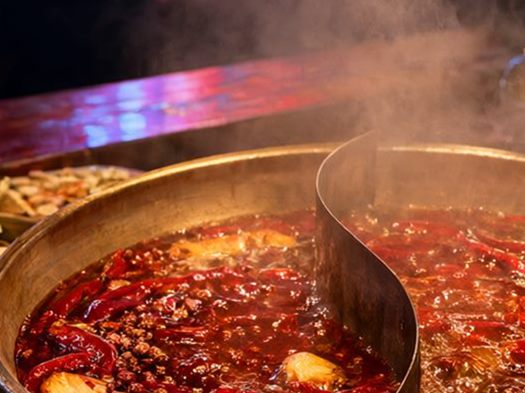
Then eat. The food is built for the climate and the climbs: hotpot that keeps a table sitting for three hours, noodles eaten standing at seven in the morning, and a cold jelly in summer that costs ¥6 and is gone in four minutes. After a day of vertical walking, a meal that takes three hours is not indulgence but logistics.
Finding the entrance
Ask for a metro exit plus a landmark, not a street address. Exit 3B next to the bank is more useful than a floor number that belongs to a different building.
Hotels often list the entrance on the upper road. Message ahead and ask which level the taxi should stop at; the answer saves twenty minutes with a suitcase.
Lifts in residential blocks are public. Walking into a tower to reach the street above is normal here rather than trespassing, though the door staff may still ask where you are going.
Questions travellers ask
- Why is Chongqing so hard to navigate?
- Because it is built on hills, so streets stack instead of crossing. A building can have entrances on four roads at four heights, and a flat map shows those roads as if they met. Ask for metro exits and landmarks, allow 40 metres of climb per kilometre, and expect to take a lift to reach a street.
- Is the Liziba monorail worth seeing?
- Yes, but ride it as well as photograph it. Line 2 passes through a residential block between the seventh and eighth floors every few minutes, fares are ¥2–7, and the viewing platform below is free. Go at dusk, when the carriages and the windows are both lit, and expect a crowd.