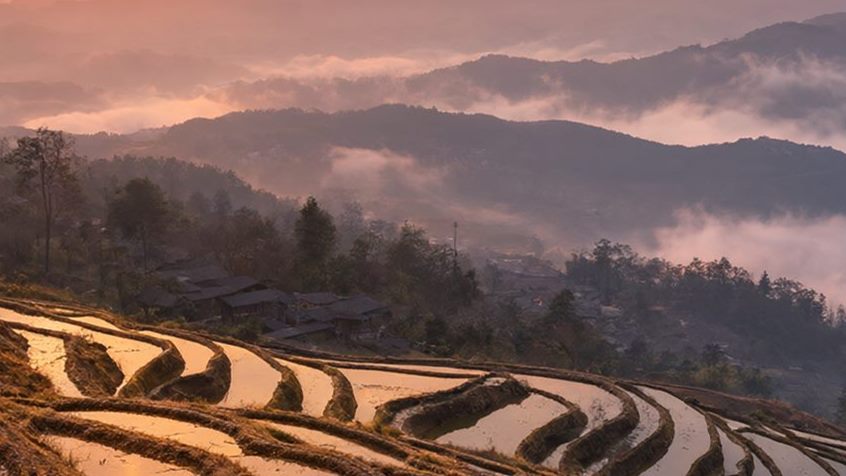
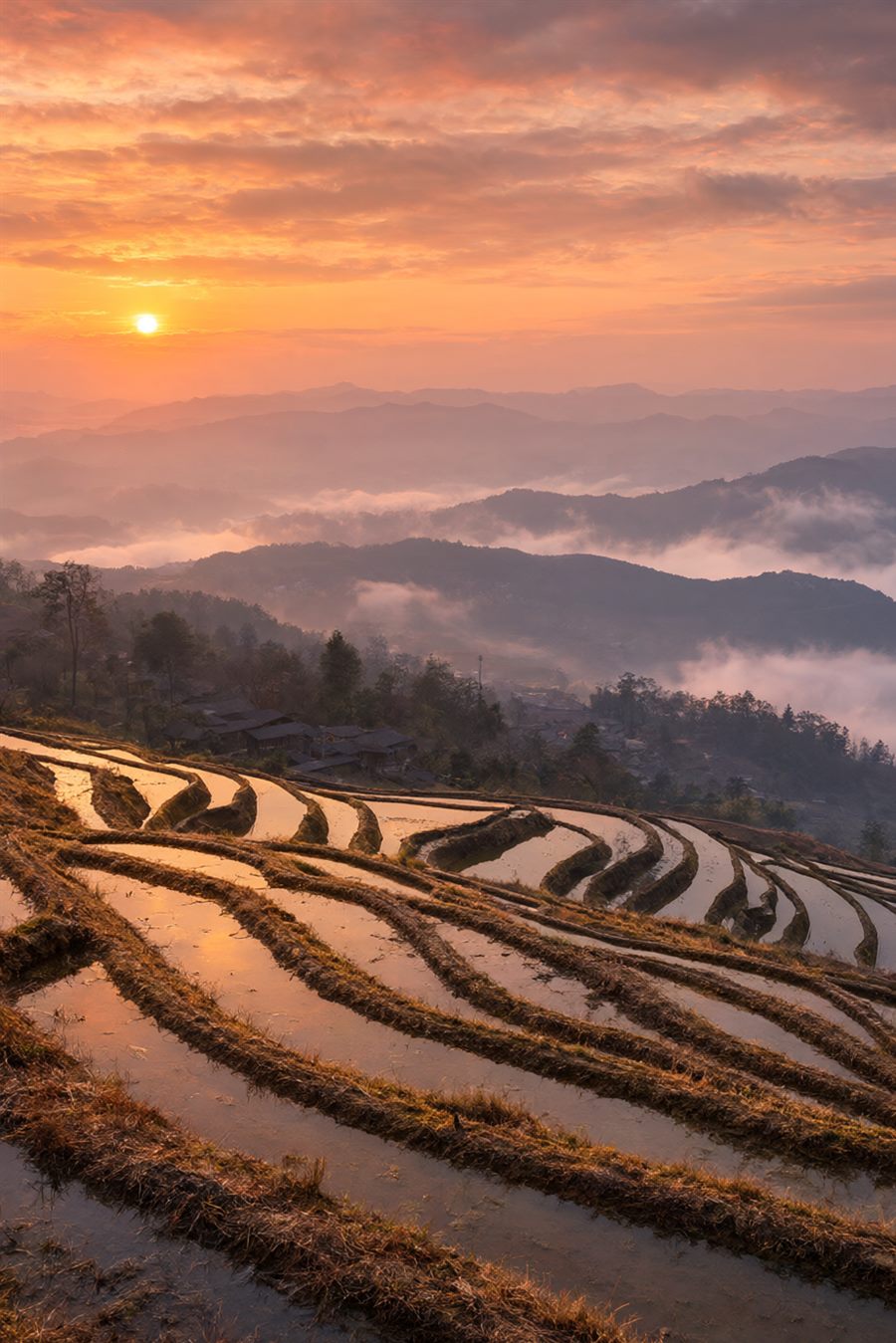
From November to March the Hani terraces above the Red River are mirrors. Water is led down from the forest in channels dug centuries ago, and every terrace holds a sheet of sky, so sunrise arrives twice: once above the ridge and once in the paddies below. The villages are still working farms, not exhibits, which is the point and the etiquette.
元阳 YuányángYunnan · Southwest ChinaIdeal 3–4 daysWindow Nov – Mar
Terraces
1,300 yearsHani construction; UNESCO since 2013
Altitude
1,400–2,000 mXinjie sits at about 1,570 m
Sunrise
07:00–07:45Duoyishu, December and January
Road
6–7 hKunming to Xinjie, about 330 km
Ticket
¥100multi-site pass, three days
Chapter 01 — Orientation
A staircase of water between two climates
Yuanyang county drops from the Ailao mountains to the Red River, from about 2,000 metres to 200. The county town, Nansha, sits in the hot valley; the old town and the terraces are up at Xinjie, 30 kilometres and 1,400 metres above it. The three classic viewpoints are spread around Xinjie: Duoyishu to the east for sunrise, Laohuzui to the west for sunset, and Bada on the ridge between them for either.
The terraces follow the water calendar rather than the tourist one. Fields are flooded from November, reach full mirror in December and January, and are planted from February; by June the slopes are green and by September they are gold before the harvest. Winter also brings fog, which can hide the whole valley at dawn and then lift in ten minutes. Build in a second morning if the first one fails.
The Hani have farmed these slopes for at least 1,300 years, using a system of sacred forest at the ridge, village in the middle and terraces below, so that water is filtered and shared rather than lost. The villages are built of dark timber and mushroom-shaped granaries; the rice is red. Tourism has arrived, but outside the viewpoints it is still a working agricultural landscape with pigs, drying grain and no English.
Two nights is the useful minimum, which gives you two sunrises and one sunset. Three nights adds a village walk and a market, and a fourth lets you come via Jianshui, which has the best old town in southern Yunnan. Stay in Xinjie or in Pugaolao village among the terraces, and hire a driver for the dawn runs.
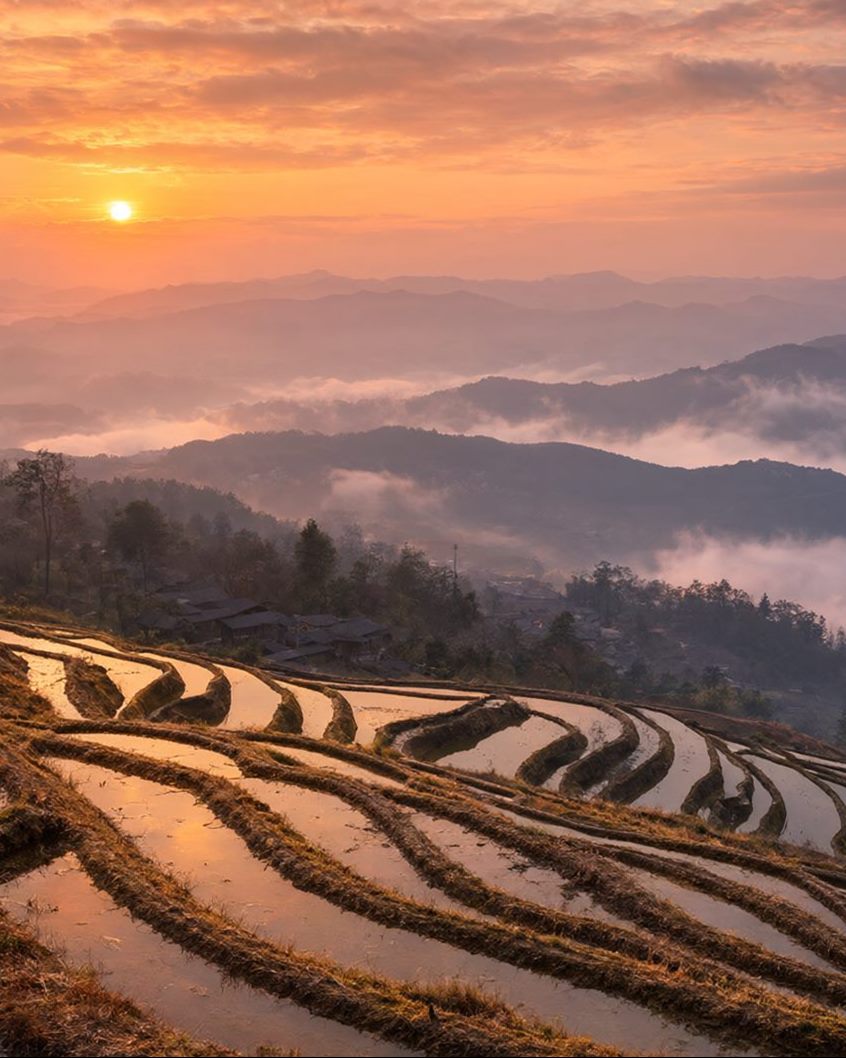
First light over the terracesWater and ridge linesMist below the ridge
Chapter 02 — Four days
Four days, two of them before dawn
Day 1 AM
Kunming to Jianshui
Take the morning bus south to Jianshui, three and a half to four hours on the expressway. Spend the afternoon in the old town: the Confucian temple, the Zhu family garden and the wells where locals still draw water. Eat a bowl of Jianshui grass-bud rice noodles and sleep in the old town rather than pushing on to the terraces in the dark.
Day 2 AM
Up to the terraces
The road from Jianshui to Xinjie takes two and a half to three hours, climbing through banana and then pine. Check in, visit Qingkou to see the mushroom houses, and be at Laohuzui by 18:00 for sunset. The viewpoint is a concrete platform with a car park; walk 200 metres along the ridge for a quieter angle and stay until the light has gone completely.
Day 3 AM
Duoyishu at first light
Leave the guesthouse at 06:15 for the 35-minute drive to Duoyishu. The platform fills by 06:45 in December; the sun clears the ridge around 07:40. Stay for an hour after the first light, when the mist moves and the crowds leave, then drive to Bada for the middle of the day and a late lunch. Sleep in the afternoon; the altitude is mild but the hours are not.
Day 4 AM
Market, then the road out
If the market falls in a nearby village, go at 8am: Hani women in indigo, pigs in baskets, tobacco and red rice. Then take the bus back to Kunming, six to seven hours, or the bus down to Mengzi, about two hours, for the high-speed train. Allow the whole day either way.
Chapter 03 — Six sights
Where the light lands
01 · The landscape
The Hani terraces 哈尼梯田
A UNESCO cultural landscape of about 16,000 hectares, farmed continuously for more than a millennium. The ¥100 pass covers the main viewpoints and Qingkou village for three days. Come for the water: December and January give you mirrors, February gives you planting, September gives you gold. Outside those months the terraces are still beautiful, but they are not the photograph you came for.
¥100 passNov–Mar bestdawn and dusk2 days
日
02 · Sunrise
Duoyishu 多依树
The classic sunrise viewpoint, 25 kilometres east of Xinjie, with a wide concrete platform above a bowl of terraces. Arrive by 06:30, take a place at the rail and be patient: the good light comes twenty minutes after the sun appears, when the mist starts to move. Tripods are allowed but the platform is crowded; a small ledge further down the path is often quieter.
includedsunrise 07:00–07:4525 km east2 h
虎
03 · Sunset
Laohuzui 老虎嘴
Tiger's Mouth, a viewpoint above a deep amphitheatre of terraces on the western side, and the best place to end the day. The sun drops behind the ridge around 18:45 in winter and the water turns copper, then grey. The platform is a short walk from the road and there are stalls selling tea and grilled corn; stay until the last colour goes.
includedsunset 18:30–19:0020 km west45 min
坝
04 · The middle
Bada 坝达
A long ridge of terraces 14 kilometres from Xinjie, on the loop towards Duoyishu, with a village at the top and a view that runs for kilometres. It works at both ends of the day, which makes it the sensible fallback when Duoyishu is fogged in. The terraces here are steeper and narrower than at Duoyishu, and the paths between them are farm tracks, not trails.
includedsunrise or sunset14 km from Xinjie1–2 h
菇
05 · The village
Qingkou 箐口
A Hani village of dark timber houses and mushroom-shaped granaries, close to Xinjie and included in the pass. It is the most visited village and the most convenient, with a small museum and a path down through the terraces. Walk the lanes early or late, ask before photographing people in their doorways, and do not climb onto the terrace walls.
included1 h walknear Xinjieeasy
市
06 · The market
Shengcun market 胜村
The village markets rotate between settlements on a five-day cycle, and Shengcun's is one of the biggest. Mornings bring red rice, bamboo shoots, tobacco, live chickens and indigo-dyed cloth; by noon it is over. Ask at your guesthouse which market falls tomorrow rather than trusting a fixed schedule, and bring small notes, since few stalls take a phone.
freemarket morningsrotating days1–2 h
Light, mud and the platform
The difference between a good sunrise and a wasted one is forty minutes. Be on the platform before first light, with a torch, a jacket and a tripod if you have one; the temperature at 1,800 metres in December is 5–10°C and the wind makes it feel colder. Fog is common and unpredictable, which is why two mornings beat one.
The paths between terraces are narrow, wet and built for feet, not boots. Do not walk on the terrace walls, which are the only thing holding the soil up, and do not accept offers from anyone who says they can get you onto a private viewpoint for a fee. Drones are restricted near villages and need registration; ask before flying, and expect a refusal.
Questions travellers ask
When is the best time to see the Yuanyang terraces?
December and January, when the flooded terraces are full mirrors and the light is clearest. November and February are nearly as good with fewer visitors, February brings planting and green shoots, and September gives gold before the harvest. June to August is green but wet, with fog that can hide the valley for days.
How do you get to Yuanyang from Kunming?
The direct bus from Kunming to Xinjie takes six to seven hours and costs about ¥120–160. A more comfortable route is Kunming to Jianshui by bus, three and a half to four hours, then two and a half hours up to Xinjie. You can also take the high-speed train to Mengzi, two and a half hours, then a bus to Nansha and 40 minutes up the hill.
Can you combine Yuanyang with Dali and Lijiang?
Yes, with Kunming as the hub. Yuanyang is south of Kunming, while Dali and Lijiang are west, so the sensible order is Kunming, Yuanyang, Jianshui, back to Kunming, then the four-hour train to Dali. Allow ten days for all three, and book the Kunming–Dali train a few days ahead in spring and autumn.