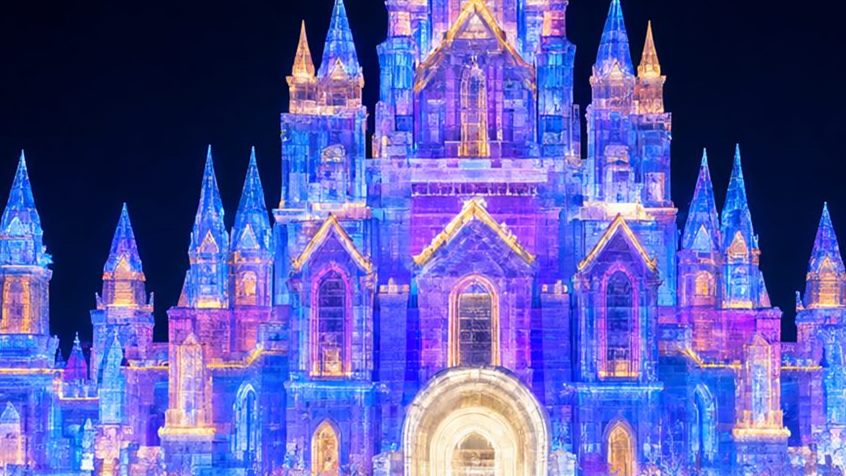
Nine million people live on the Songhua River in a city that spends five months below freezing and has decided to make a festival of it. The ice comes out of the river, the river becomes a road, and the architecture left behind by Russian railway engineers looks even stranger under snow. Harbin is not a place to endure winter. It is a place that has built an industry around it.
哈尔滨 Hā'ěrbīnHeilongjiang · Northeast ChinaIdeal 3–5 daysWindow Dec – Feb
January
-19°Caverage; nights near -25, wind colder
Ice festival
¥328Ice and Snow World, late Dec–Feb
Airport
HRB35 km; bus ¥20, 50–70 min
High-speed rail
4 h 45Harbin West–Beijing, 1,200 km
Daylight
8 hsunset just after 16:00 in January
Chapter 01 — Orientation
A river city that turned its cold into a trade
Harbin sits on the south bank of the Songhua, a broad, slow river that freezes solid from December to early April. The old commercial district, Daoli, holds Central Street: 1.4 kilometres of cobbles running from the river monument south to the station, lined with facades from the 1900s and 1930s. Daowai, to the east, is the older Chinese quarter, lower and cheaper, with markets that open before dawn. Most visitors never leave the rectangle between the two.
Winter reorganises the city. Ice is cut from the Songhua in blocks, trucked across to the far bank and stacked into a temporary city at Ice and Snow World, which opens in the last week of December. Snow sculptures go up on Sun Island, smaller ice lanterns fill Zhaolin Park, and the metro runs late. Daylight is the constraint: the sun sets just after four in January, so the sightseeing day is short and the night is the main event.
The Russian layer is real but thinner than the brochures suggest. The Chinese Eastern Railway arrived in 1898, bringing engineers, churches and bakeries; St Sophia went up in 1907 and was rebuilt in brick in the 1920s. What survives is a handful of blocks, a bread called dalieba, a red sausage and a stubborn local pride in being different from the rest of the northeast. The festival is newer, and louder.
Three nights is enough for the ice and the old streets; add two for Snow Town. Stay in Daoli within walking distance of Central Street, plan an indoor stop every two hours, and treat the cold as the thing you came to see rather than an obstacle between sights.
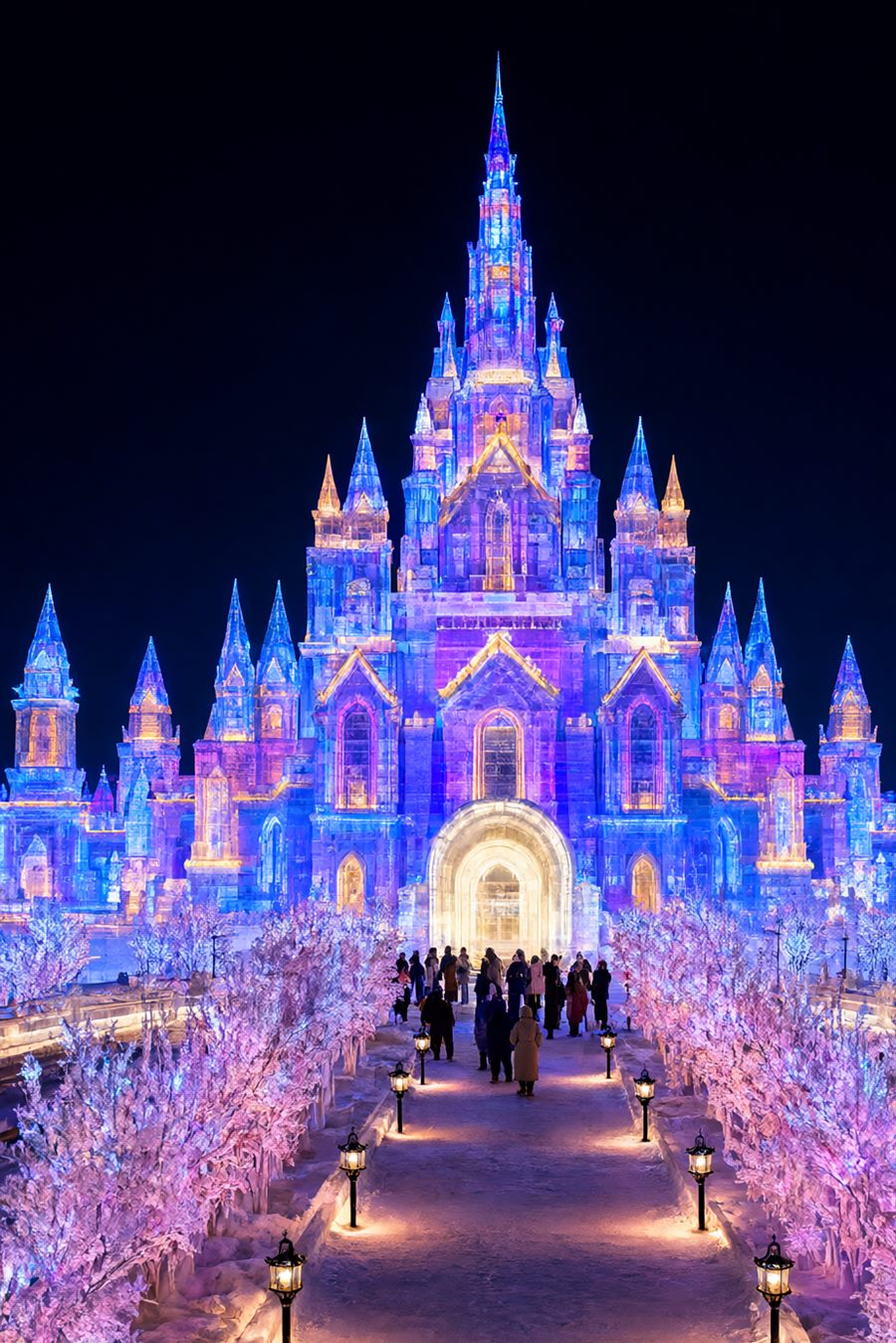
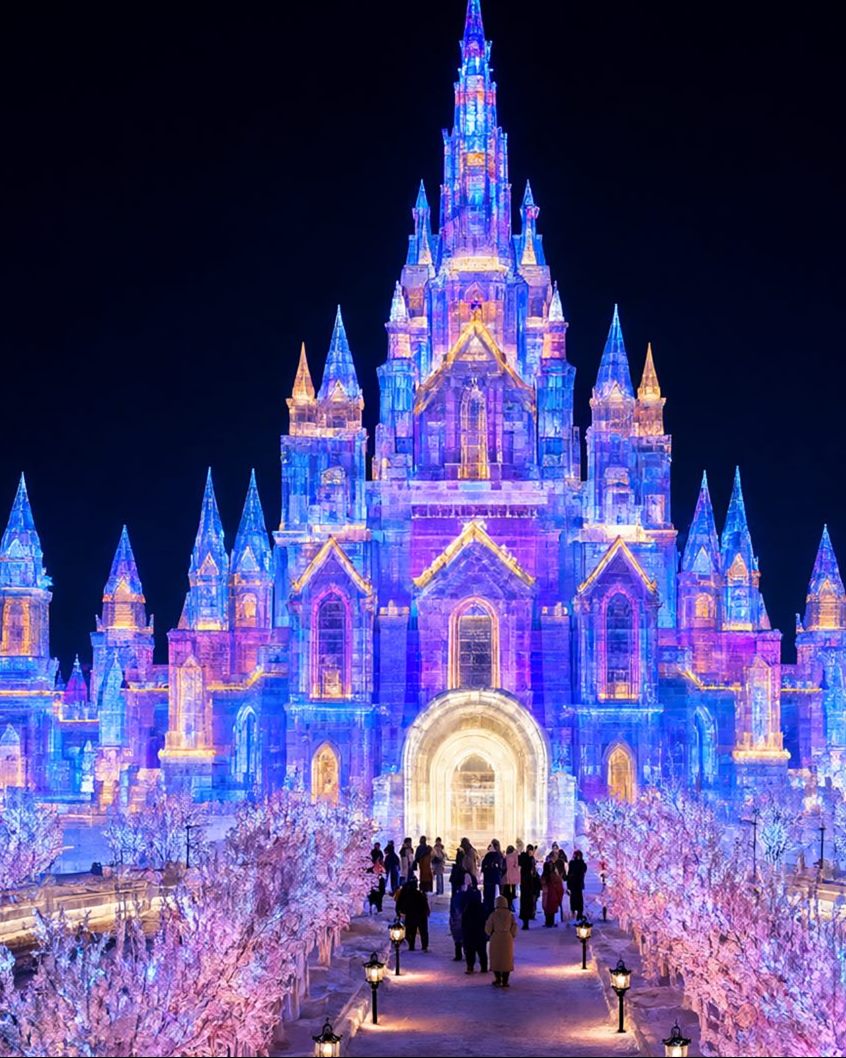
The main castle, after darkIce blocks, coloured lightThe approach, lined with frozen trees
Chapter 02 — Five days
Five days, two of them outdoors after dark
Day 1 PM
Central Street at dusk
Arrive early afternoon, check in and walk the length of Central Street as the light goes. The facades are best between 15:30 and 16:30, when the sky is still blue and the windows are lit. Look at St Sophia from the square outside, then eat guobaorou in a basement restaurant and be back out for the ice lanterns at Zhaolin Park if the cold has not beaten you.
Day 2 AM
Snow sculptures, then the ice city
Sun Island in the morning for the snow sculpture expo, which is a daytime medium and closes in the afternoon. Eat an early lunch and reach Ice and Snow World by 15:30, when there is still enough light to see the scale of the place; stay until the lights and the crowds peak around 19:00, then leave before the taxi queue becomes a penance. At -25, three hours outdoors is a full shift.
Day 3 AM
The frozen river
Walk down to the Songhua in the morning, when locals are out on the ice with sledges and skates. The cable car across to Sun Island is worth one crossing for the view back over the city. In the afternoon, the synagogue and the old Russian quarter around Central Street, then a long dinner: borscht, red sausage, bread and something hot to drink.
Day 4 AM
The road to Snow Town
The bus to China Snow Town takes five to six hours from Harbin, so leave by seven and accept that the day is mostly transport. The village itself is small: wooden houses under a metre of snow, a main street, and hills behind. Walk up to the viewpoint above the village before the light goes, then eat at the guesthouse and stay the night.
Day 5 AM
Snow Town at first light
The village is at its best before nine, when the tour buses have not arrived and the smoke is still hanging over the roofs. Walk the back lanes, then take the bus back to Harbin in the afternoon, or continue to Mudanjiang for the high-speed train. If you have no appetite for a five-hour road trip, skip Snow Town and give the extra day to the ice festival and a slower morning.
Chapter 03 — Six sights
What is worth the frostbite
01 · The main event
Ice and Snow World 冰雪大世界
A temporary city of ice blocks on the far bank, rebuilt every winter and lit from inside after dark. The scale is the point: towers, bridges and a castle facade that take an hour to walk around. Tickets are ¥328, best booked online; bring your passport, go late afternoon to see the carving in daylight, then stay for the lights. The ice slides have queues; the far corners do not.
¥32811:00–21:30night is the point3–4 h
堂
02 · The old city
St Sophia Cathedral 圣索菲亚教堂
A brick Byzantine church with green onion domes, built for Russian railway workers in 1907 and rebuilt on a larger scale in the 1920s and 1930s. It has not held services for decades; inside is a small museum of the city's architecture, which explains more about Harbin than the label suggests. Twenty minutes in the square outside is enough if the temperature is below -20.
¥208:30–17:00museum inside30 min
街
03 · The promenade
Central Street 中央大街
The cobbles are original, the facades are a mix of baroque, art nouveau and whatever the 1920s could afford, and the whole street is pedestrian. It runs 1.4 kilometres from the river to the station, with a hotel that has been trading since 1906 and queues for frozen yoghurt in July. In January, walk it at dusk, buy a stick of ice cream anyway, and duck into a side street for cheaper food.
free1.4 kmbest at dusk1–2 h
江
04 · The ice road
The Songhua River 松花江
By January the river is a kilometre of white, crossed by pedestrians and cleared into slides and skating rinks. Locals treat it as a park: sledges for hire, old men ice-fishing, a few swimmers who cut a hole and go in. The cable car to Sun Island costs about ¥50 one way. Only walk where others are walking; the current keeps some channels thin.
freeJan–Febslides ¥30–801–2 h
灯
05 · The small ice
Zhaolin Park 兆麟公园
The original ice lantern show, running since 1963, and a gentler alternative to the big site across the river. Ice is carved into animals, pagodas and arches, lit in primary colours, and arranged along a short loop that takes 45 minutes. It is popular with families and Chinese tour groups, and it is small enough that you can see it on the way to dinner rather than making a night of it.
¥30–5016:30–21:00in festival weeks45 min
雪
06 · The side trip
China Snow Town 雪乡
A forestry village in Hailin, 280 kilometres southeast, where the snow piles onto the roofs in thick, rounded caps and the whole place looks like a model. It is a five to six hour road trip from Harbin, best done as an overnight. The entrance fee is ¥95 and the village is unashamedly commercial; the back lanes and the hillside above it are still worth the journey.
¥95280 km5–6 h by roadovernight
Dressing for minus 25
The cold is dry and still until the wind gets up, and then it is not. Layers matter more than any single coat: thermal base, fleece or down mid-layer, windproof shell, and trousers that are not jeans. Boots need a thick sole and room for two pairs of socks; rental boots are available at Ice and Snow World but they are ugly and stiff.
Phones die at -20 within minutes when exposed, so keep the battery in an inside pocket and accept that you will take fewer photographs than you planned. Frostbite arrives quietly on cheekbones, fingertips and earlobes; go inside every two hours, drink something hot, and do not use alcohol as a warming strategy. It widens the blood vessels and loses heat faster.
Questions travellers ask
When is the Harbin ice festival?
The festival officially opens on 5 January and runs into late February, but Ice and Snow World usually opens in the last week of December and closes when the ice begins to soften, sometimes in early March. January is the safest bet: thick ice, reliable lighting and the coldest, clearest nights. The ice sculptures are weather-dependent, so check before booking a February trip.
How cold does Harbin get in winter?
January averages about -19°C, with daytime highs of -12 to -18 and nights near -25. Wind makes it feel colder, especially on the river and at the ice festival. A thermal base layer, a down mid-layer, a windproof shell, insulated boots and a hat that covers the ears will see you through three hours outdoors at a time.
Is China Snow Town worth the trip?
It is worth one night if you want the postcard village under deep snow, but it is a five to six hour road trip each way and the main street is heavily commercial. Go in the morning for the quiet lanes, sleep in the village rather than day-tripping, and skip it if your trip is only three days.