Suzhou made its money from silk and its reputation from gardens. For six centuries retired officials spent their fortunes building miniature landscapes of rock, water and pavilion inside the city walls, and nine of them survive as UNESCO sites. The canals that carried the silk are still there, quieter than the guidebooks imply, and best seen before the day trippers arrive from Shanghai.
苏州 SūzhōuJiangsu · Yangtze deltaIdeal 3–4 daysWindow Mar – May & Sep – Nov
Gardens
9 UNESCO¥40–80 each; the largest is ¥70–80
Shanghai
25 minhigh-speed rail to Hongqiao, ¥40
Pingjiang Road
1.6 kmbest before 8am
Silk
¥200–800per metre; check the label
Population
12.9 millionthe old town is a fraction of it
Chapter 01 — Orientation
A walled town of canals, with gardens inside
The old town sits inside a rectangular moat, crisscrossed by canals and threaded with lanes. Pingjiang Road runs north–south along the eastern canal; Shantang Street runs west from the Changmen gate; the great gardens cluster in the north-east, within walking distance of each other. The railway stations are north of the moat, the Panmen gate and pagoda are in the south-west, and the modern city spreads east towards the industrial park.
The gardens are not parks. They are private compositions, built by scholar-officials who wanted a mountain, a forest and a lake within a courtyard, and they work by compression: a rockery that stands for a range, a window that frames a single branch, a wall that hides most of the view until you turn a corner. Visiting three in a day is possible; visiting one properly, at opening, is better.
Suzhou is 2,500 years old and was wealthy long before Shanghai existed. The Grand Canal made it a grain and silk depot, the workshops along the canals dyed and wove for the imperial court, and Kunqu opera developed here in the sixteenth century. The old town is protected by height limits, which is why it still feels low and grey and walkable, and why the light at 7am is worth setting an alarm for.
Two nights is the minimum: one for the gardens at opening, one for the canals and a water town. Add a night if you want Shanghai as well. Stay inside the moat near Pingjiang Road, and treat the gardens as morning work rather than afternoon sightseeing.
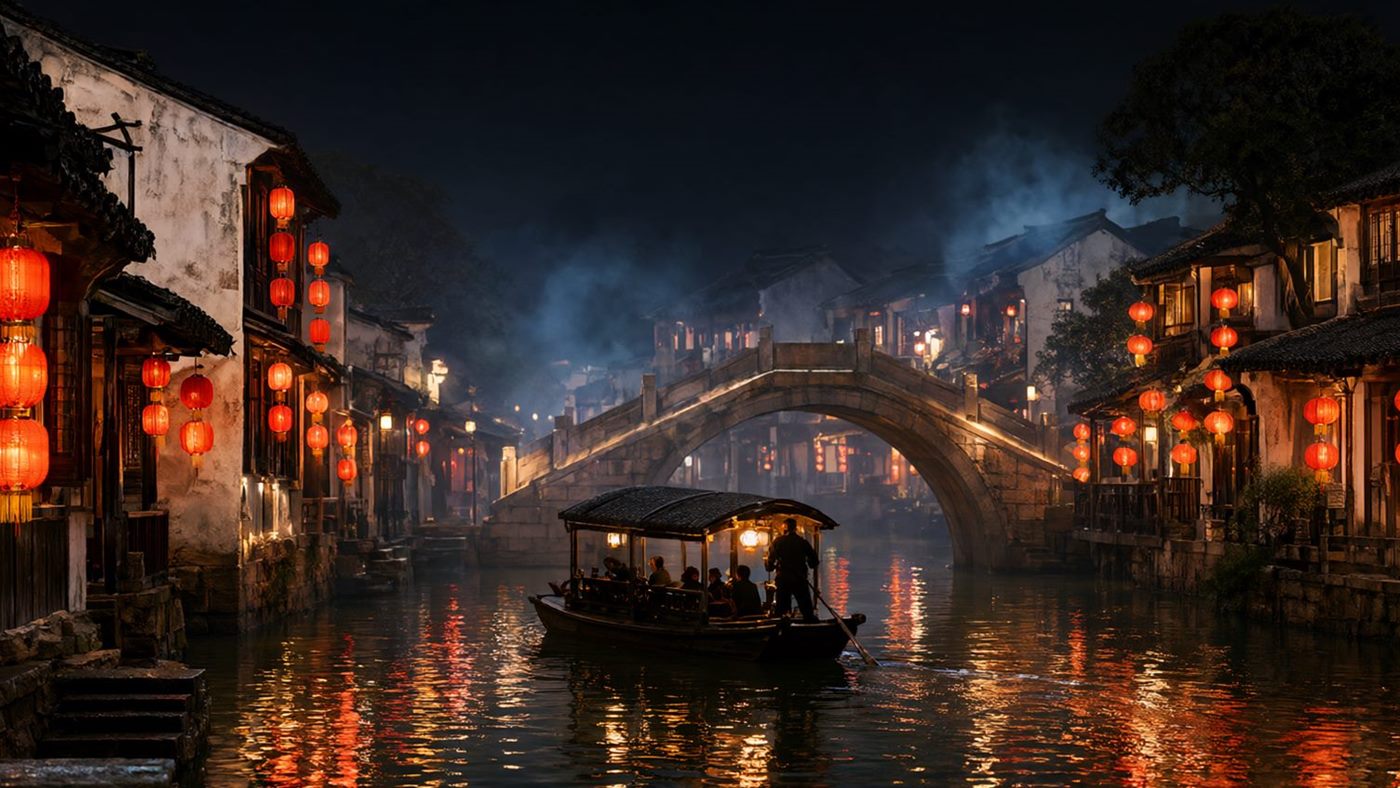
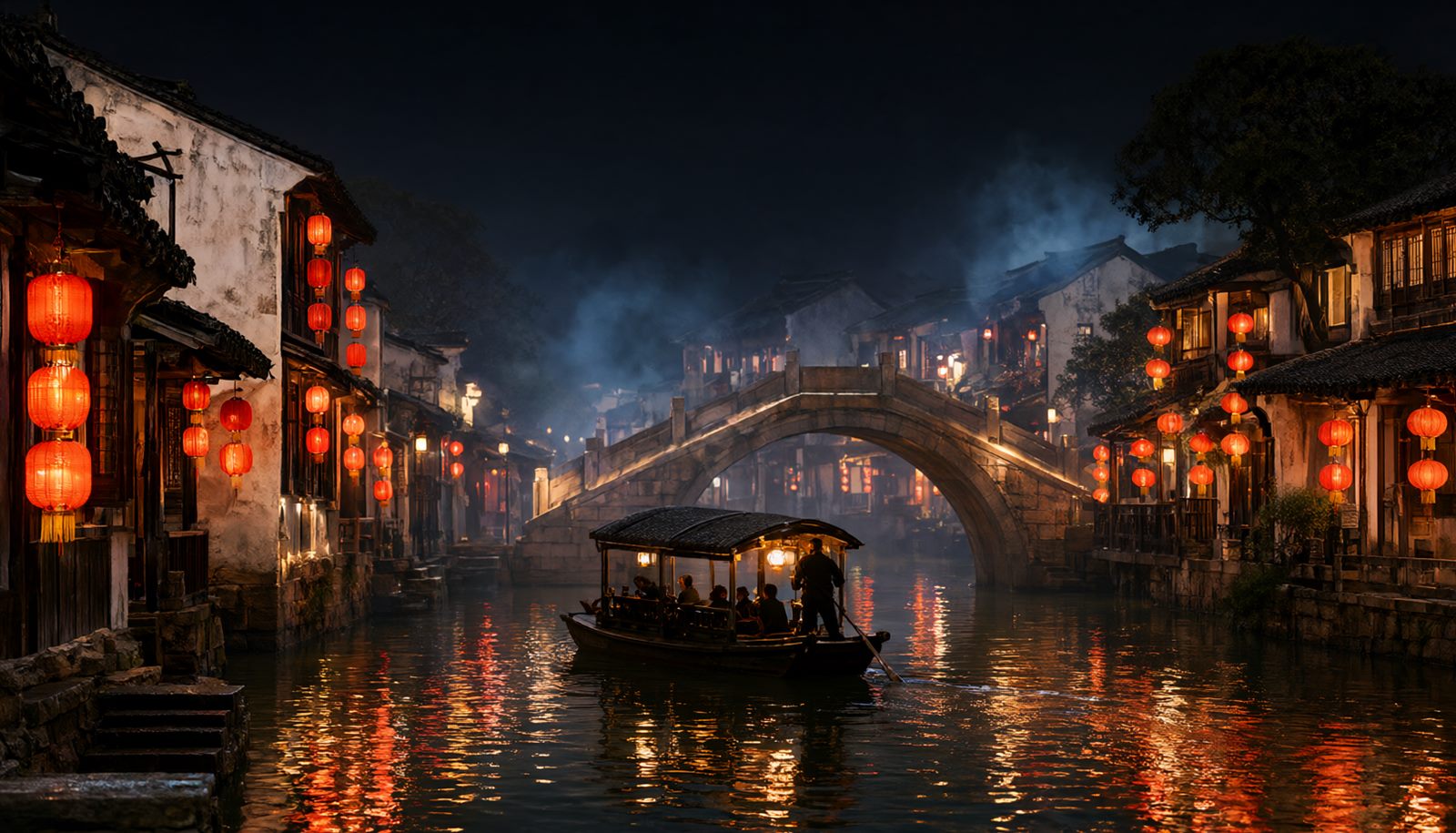
The canal after darkLanterns and whitewashA Jiangnan water town
Chapter 02 — Four days
Four days, two of them before breakfast
Day 1 PM
Pingjiang Road, then opera
Arrive, drop the bag and walk Pingjiang Road from north to south as the lanterns come on. The canal is at its best between 17:00 and 18:00, when the day trippers have gone and the residents are out. Eat a bowl of Suzhou noodles, then catch the 14:00 Kunqu performance at the opera museum if you have arrived in time; if not, go tomorrow afternoon instead.
Day 2 AM
The gardens at 7:30
Be at the Humble Administrator's Garden gate at 7:30, when it opens and the tour groups are still in bed. Two hours is enough for the main halls, the pond and the bonsai garden. Walk ten minutes to the Master of the Nets, which is a tenth of the size and twice as concentrated. By 11:00 the lanes are full; retreat for lunch and a nap.
Day 3 AM
Tongli, by metro
Line 4 runs to Tongli station, 20 kilometres southeast, with a shuttle bus for the last two kilometres. The water town costs ¥100 and is a proper lived-in place, with a canal, three bridges and a garden of its own. Go early, walk the back lanes away from the main street, and be back in Suzhou for dinner. Zhouzhuang is the busier alternative, 30 kilometres away by bus.
Day 4 AM
Shanghai and back
The high-speed train to Shanghai Hongqiao takes 25 minutes and runs every few minutes. Leave at 8am, see the Bund before the crowds, and take a late afternoon train back; the last services run until about 22:00. If you would rather stay put, spend the day on the Silk Museum, the Panmen gate and a canal boat along the Shantang section.
Chapter 03 — Six sights
What is worth the ticket
拙
01 · The largest
Humble Administrator's Garden 拙政园
The biggest and most famous of the classical gardens, laid out in 1513 around a series of ponds, pavilions and borrowed views of a distant pagoda. It is also the busiest, which is why the opening hour matters. Follow the west side first, where the tour groups take longest to reach, and leave the main hall until they have passed through.
¥70–807:30–17:30book online2 h
平
02 · The canal
Pingjiang Road 平江路
A 1.6-kilometre lane along a canal, with stone bridges, whitewashed houses and willows, and enough tea shops to keep you walking slowly. It is arguably the most photographed street in Suzhou and by 10am it is a queue. Come at 7am, when the shopkeepers are washing the pavement, or at dusk, when the lanterns are on and the day crowds have gone.
free1.6 kmbefore 8am2 h
网
03 · The smallest
Master of the Nets 网师园
The smallest of the great gardens and the one most visitors remember. A central pond, a handful of pavilions and a courtyard with a rockery that manages to suggest a mountain range in a few metres. It is also the only garden that opens some evenings for performances, with a handful of musicians and opera singers stationed around the pond.
¥407:30–17:00evening shows1 h
丝
04 · The trade
Suzhou Silk Museum 苏州丝绸博物馆
A small, well-made museum that explains why this city was rich: mulberry leaves, silkworms, reeling, dyeing and the Jacquard looms that preceded computers. There are working demonstrations most mornings and a shop that sells scarves by weight rather than by label. It takes an hour and changes the way you look at the canal-side workshops.
¥159:00–17:00demonstrations AM1.5 h
昆
05 · The opera
Kunqu Opera Museum 昆曲博物馆
Kunqu is the oldest surviving form of Chinese opera, slow and stylised, with a flute, a drum and a single singer holding a note for an improbable length of time. The museum occupies an old guild hall and stages a short programme most afternoons; tickets are cheap and the audience is mostly local. Even twenty minutes is enough to understand the form.
¥30–100show 14:001.5 hsubtitles limited
同
06 · The water town
Tongli 同里
Twenty kilometres southeast, a canal town with three bridges at its centre, a retired scholar's garden and enough residents to keep it from feeling like a film set. The ¥100 ticket covers the main sights; the pleasure is in the lanes behind them. Metro Line 4 gets you to Tongli station, then a shuttle bus covers the last two kilometres.
¥10020 kmmetro Line 4full day
The garden hour
Every garden in Suzhou is a different experience at 7:30 and at 11:00. The gates open at 7:30, the first coach arrives around 9:30, and by 10:30 the narrow corridors are single file. Book online with your passport number, arrive ten minutes early, and go straight to the furthest corner before working back towards the entrance.
Rain is not a problem; wet stone and dripping eaves suit the gardens better than sunshine. What you cannot do is bring a tripod into the main halls, or expect quiet on a Saturday in April. If you only see one garden, make it the Humble Administrator's; if you see two, add the Master of the Nets for contrast rather than the Lingering Garden for size.
Questions travellers ask
Which Suzhou garden should you visit?
If you see one, make it the Humble Administrator's Garden: the largest, the most varied and the easiest to reach from the old town. If you see two, add the Master of the Nets, which is a tenth of the size and far more concentrated. Both are best at 7:30, before the coach groups arrive around 9:30.
Is Suzhou worth a day trip from Shanghai?
Yes. High-speed trains take 25 minutes from Shanghai Hongqiao and run every few minutes, with returns until about 22:00. Leave at 8am, see one garden at opening and walk Pingjiang Road before lunch, then take a late afternoon train back. Staying one night gives you the canals at dusk and dawn, which is the better version.
Tongli or Zhouzhuang?
Tongli is 20 kilometres from Suzhou and reachable by metro Line 4 plus a short shuttle, with three stone bridges and a resident population that keeps it alive. Zhouzhuang is 30 kilometres away, busier and more polished. If you have limited time and no car, Tongli is the easier and calmer choice.