Season · Spring
By the ChinaTravel.fly field desk 6 min read Updated Nov 2026
- Window
- Mar–Maybest late March to mid-May, moving north
- North highs
- 12–24°Cbut 6°C at night in March
- Dust
- Mar–Aprtwo or three bad days a month in Beijing
- Crowds
- 1–5 MayLabour Day, the first big domestic surge
Spring in China runs on a diagonal. It starts in Yunnan and Guangxi in February, reaches the Yangtze delta in late March, and arrives in Beijing in the second half of April. Chasing it north is one of the few good reasons to plan a trip around a calendar rather than a list of cities.
What comes with it is less romantic: dust in the north, rain in the south, and a fifteen-degree swing between noon and midnight.
The blossom calendar
Plum blossom, 梅花, opens first, from late January in Hangzhou and Nanjing and through February in Wuhan. It is a cold-weather flower and looks best against grey stone and grey sky, which is what the south provides. Cherry blossom follows in the last week of March, and the two famous avenues — one in Beijing, one in Wuhan — are packed on the weekend it peaks, announced on the news like an election result.
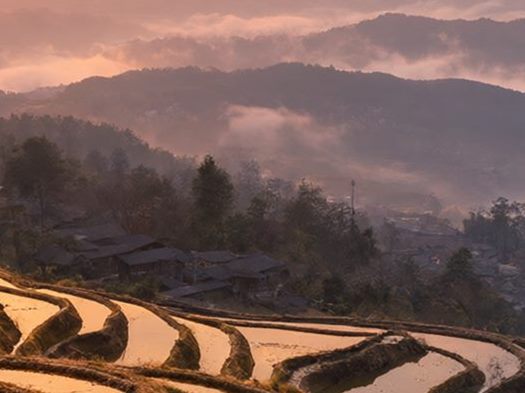
Rapeseed, 油菜花, changes a landscape: whole valleys in Wuyuan, Jiangxi, and Luoping, Yunnan, turn yellow in March and early April. Peony in Luoyang peaks for about ten days in mid-April. And in the far south-west, the Hani terraces at Yuanyang are flooded and mirror-like from January to March, before the rice goes in.
Region by region
South-west. The best spring in the country. Yunnan is dry, sunny and 18–24°C, Kunming is at its most pleasant, and the terraces and rapeseed are both on. Sichuan is green and mild, and Chengdu's teahouses are at their best before the humidity.
South. Guangxi and Guangdong warm up early, the karst is at its greenest, and the Li river is running well. Rain starts in April and gets serious in May. Guilin in March is underrated; in late April it is a wet jacket.
East. Shanghai, Suzhou, Hangzhou and the canal towns have their best six weeks from mid-March to late April: cool, green, full of flowers. Plum rain does not arrive until mid-June, so May is still usable, just hotter.
North. Beijing and the Wall are at their best from mid-April. Before that you get wind, bare trees and dust. The Forbidden City in April is comfortable; in March it is a cold courtyard with a queue. The north-east is three weeks behind.
West. The Silk Road is not a spring destination. Gansu and Xinjiang are windy, dusty and cold at night until May. Tibet is possible from April, with permits and cold mornings; Lhasa is 16°C by noon, minus five at dawn.
Spring does not arrive in China. It crosses it, on a diagonal, at about sixty kilometres a day, and you can follow it if you are willing to move. Field desk · a train south of Nanjing, late March
The dust, and the two rains
Northern spring comes with dust from the Gobi, carried on north-west wind. It arrives as a yellow haze that turns the sun into a coin and drops visibility to a kilometre. There are two or three such days a month in March and April, they are forecast a day ahead, and the response is a museum, a noodle shop, and no hike.
The rain is more orderly. In the south it is steady and warm from April. In the east, plum rain, 梅雨, begins around mid-June — technically summer, but it decides your May plans: anything outdoors in the delta is safe before 10 June.
The two weeks to avoid
Labour Day, 1–5 May, is the first domestic travel surge of the year and the one that catches foreign visitors by surprise. Trains sell out fifteen days ahead, hotel rates in scenic areas double, and any mountain with a cable car has a queue. The week after is one of the quietest of the spring. Qingming, in early April, adds three days of tomb-sweeping traffic, mostly on the roads.
Packing for a season with two opinions
Layers, not a coat. A 20°C afternoon in Beijing is a 6°C evening. A thin down jacket plus a shirt covers March to May.
A mask is not paranoia in the north in March, and neither is a folding umbrella in the south in April. Both cost ¥20 at any convenience store.
Book the long-distance trains early and the hotels late. Spring weather changes; a flexible middle of the trip is worth more than a fixed plan.
What spring costs
March and April are shoulder season almost everywhere: hotels in Shanghai and Beijing run ¥350–600, Guilin ¥250–450, Lhasa ¥300–500. May adds twenty to forty per cent.
Questions travellers ask
- Where is the best place to go in China in spring?
- Yunnan in March: dry, sunny and 18–24°C, with the Yuanyang terraces flooded and the rapeseed out at Luoping. For a classic first trip, mid-April in Beijing and the Wall is the reliable choice, with blossom, clean light and comfortable walking. Avoid the 1–5 May holiday either way.
- Is spring a good time to visit the Great Wall?
- From mid-April, yes: the trees are in leaf, the light is clean, and daytime temperatures sit around 18–22°C. March is windy and brown, with dust days, and the wall is exposed. Late April and early May are the sweet spot, but avoid the Labour Day weekend, when popular sections run at capacity.