Itinerary · 14 days
By the ChinaTravel.fly field desk 9 min read Updated Nov 2026
- Nights
- 13Beijing 3, Xi'an 2, Chengdu 2, Guilin 1, Yangshuo 3, Shanghai 2
- Rail legs
- 2four hours twenty west, three and a half further west
- Flights
- 2Chengdu–Guilin and Guilin–Shanghai, both short
- Best months
- Sep–Octwith April and May a close second
- Cost band
- ¥13,000–17,500per person, mid-range, without the flight to China
Two weeks is the first length at which China stops feeling like a sequence of queues. There is enough time for a rest day that is genuinely idle, for the Li River in the morning rather than at noon, and for Shanghai at the end as a reward rather than a stopover. It is also the first route where the map stops being a straight line and starts needing a flight.
Thirteen nights, five bases
The order is deliberately chronological: imperial north, then west, then south, then east. Each move gets shorter until the last flight east, which is the price of ending in Shanghai rather than looping back to Beijing.
| Day | Base | The move | Sleep |
|---|---|---|---|
| 1 | Beijing | Arrive, hutongs, an early duck | Beijing |
| 2 | Beijing | Forbidden City, Jingshan, hutong lunch, Temple of Heaven | Beijing |
| 3 | Beijing | Wall day at Mutianyu or Jinshanling; back for dinner | Beijing |
| 4 | Xi'an | 08:00 rail west, 4 h 20; wall at dusk | Xi'an |
| 5 | Xi'an | Army at 08:30, museum or pagoda, quarter at night | Xi'an |
| 6 | Chengdu | 09:00 rail, 3 h 20; teahouse, then hotpot | Chengdu |
| 7 | Chengdu | Pandas at 07:30, sleep, opera in the evening | Chengdu |
| 8 | Guilin | Morning flight, 1 h 50; lakes, rice noodles, early night | Guilin |
| 9 | Yangshuo | Li River boat 09:30–14:00, then nothing | Yangshuo |
| 10 | Yangshuo | Yulong raft, bicycles, fields | Yangshuo |
| 11 | Shanghai | Slow morning, afternoon bus, 18:30 flight, in by 21:00 | Shanghai |
| 12 | Shanghai | Bund early, museum, French Concession | Shanghai |
| 13 | Shanghai | Suzhou day trip, 25 minutes each way | Shanghai |
| 14 | — | Maglev to PVG, 7 min 20 | — |
The first week: two capitals and a wall
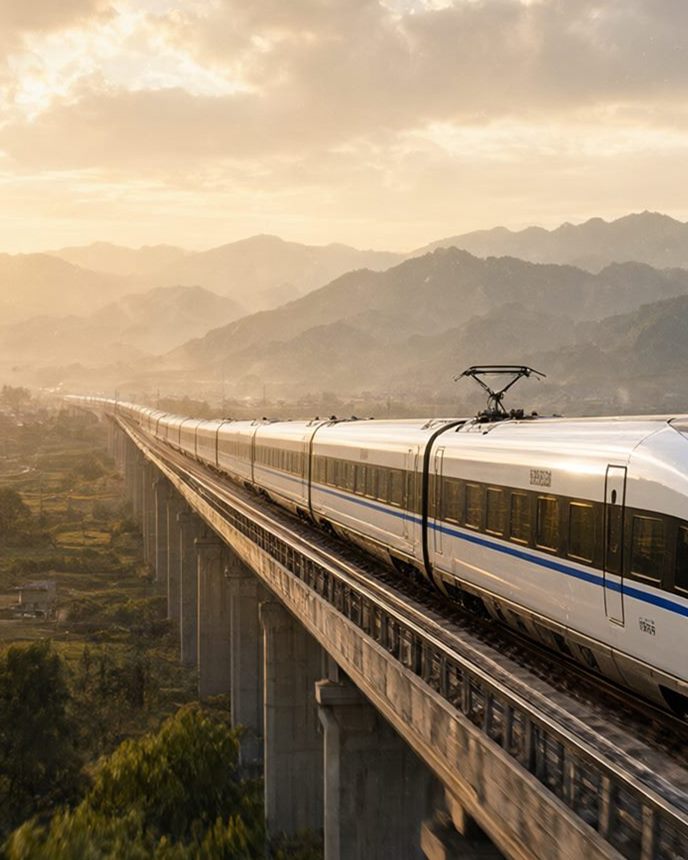
Beijing gives you the palace and the wall in three nights if you keep the first evening light. The 08:00 train west is the hinge of the whole fortnight: four hours twenty, ¥515, and you are on the Xi'an city wall by five with a bicycle and a setting sun. Two nights there is enough for the army at opening, the Shaanxi History Museum in the afternoon, and a last walk through the Muslim Quarter before the 09:00 departure.
Chengdu is the hinge, not the detour
Xi'an to Chengdu is three hours twenty through the Qinling tunnels, and the city that comes out the other end runs at half the speed. Two nights buys the panda base at 07:30 (¥55, timed slots, seven days out), a morning in People's Park with a ¥20 tea and a hundred retired people dancing, and one hotpot that ruins all other hotpots. The Sichuan opera at ¥150–320 is a tourist show and still worth an evening.
Chengdu is also where the route stops being a railway. There is a rail option to Guilin, roughly six hours with a change at Guiyang, and it eats the day. The 1 h 50 flight costs ¥700–1,100 and lands you in time for a bowl of Guilin rice noodles and a walk around the lakes.
The river, and the two days that follow it
The Li River boat leaves between nine and eleven and takes four and a half hours to Yangshuo, ¥215–450 depending on the deck. Sit on the left for the first hour, then move to the back rail between Yangdi and Xingping, where the peaks stack up and the postcard happens without warning. Nobody needs the lunch.
Yangshuo then earns three nights by doing very little. A bamboo raft on the Yulong is ¥240 for two, ninety minutes, poled rather than motored, with one small weir that soaks everyone's shoes. Bicycles are ¥40 a day and the fields west of town are the point. The awkward part is leaving: the airport is back in Guilin, so day eleven is a morning in the fields, a 15:00 bus, and an 18:30 flight that puts you in Shanghai by nine.
The loop only works because the last four days ask nothing of you except to be somewhere pleasant at sunset. Field desk · Yulong River, 17:20

Shanghai at the end, on purpose
Two nights and a day is the right allocation: the Bund at seven in the morning, when it belongs to tai chi and joggers, the Shanghai Museum at ten, the French Concession in the afternoon, and Suzhou on the last full day. Twenty-five minutes and ¥40 each way, a garden at opening, a canal walk, and a late train home. The Maglev on the final morning is ¥50 and seven minutes twenty, which is the only airport transfer in China worth doing for its own sake.
What two weeks costs
Budget ¥13,000–17,500 per person, mid-range, excluding the flight into Asia. Rail is ¥780 for the two legs; the two domestic flights add ¥1,400–2,300. Accommodation is the biggest line: Beijing and Shanghai at ¥400–800 a night, Yangshuo riverside rooms at ¥350–700, Chengdu the cheapest at ¥300–550. Tickets and boats come to ¥900–1,400. Food, at ¥150–300 a day, is where the range widens.
The two flights, booked properly
Chengdu–Guilin. Book ten days out; the morning departures are cheap and the afternoon ones are not. Both Chengdu airports are far from the centre, so allow ninety minutes.
Guilin–Shanghai. The last useful departure is around 19:00 and the airport is 28 km from town. Do not book a 16:00 flight and a Yangshuo morning in the same plan.
Luggage. Chinese domestic fares include 20 kg checked. A 24-inch case is fine; two of them are not.
Questions travellers ask
- Is fourteen days enough for five places in China?
- For this loop, yes, because four of the five are close together and the two flights are under two hours. The pace is one big sight a day with afternoons free. If you want Zhangjiajie or the Silk Road as well, you need three weeks, not two.
- Can the fourteen-day route be done without flying?
- Technically. Chengdu to Guilin is about six hours by rail with a change at Guiyang, and Guilin to Shanghai is around ten, which costs you a full day and most of another. Two short flights are the honest answer, and they add ¥1,400–2,300 to the trip.