Itinerary · 10 days
By the ChinaTravel.fly field desk 8 min read Updated Nov 2026
- Nights
- 9Kunming 1, Jianshui 1, Yuanyang 2, Dali 2, Lijiang 2, Shangri-La 1
- Rail legs
- 2Dali–Lijiang and Lijiang–Shangri-La; the rest is road
- Best months
- Nov–Marthe terraces are mirrors; the plateau is clear and cold
- Cost band
- ¥7,500–10,500per person, mid-range, including the flight out
- Altitude
- 1,570–3,300 mShangri-La is the only stop that needs care
Most Yunnan itineraries are a list of towns joined by a bus timetable nobody prints. This one is a climb: Kunming at 1,890 metres, the red-earth south, the Hani terraces at 1,900, Dali on its lake, Lijiang in a valley, and Shangri-La up where the air thins and the houses grow thick walls. The distances are not large. The roads are.
Nine nights, four climates
Two nights at the terraces is the only non-negotiable: one morning is never guaranteed in fog season. Everything else can flex by a night, and the last stop can be cut if the altitude does not appeal.
| Day | Base | The move | Sleep |
|---|---|---|---|
| 1 | Kunming | Arrive, Green Lake, a bowl of crossing-the-bridge noodles | Kunming |
| 2 | Jianshui | 09:00 bus south, 3 h 30; Confucian temple, old town at dusk | Jianshui |
| 3 | Yuanyang | Morning in the lanes, 2 h 30 bus up to Xinjie, Qingkou village | Xinjie |
| 4 | Yuanyang | Duoyishu at 06:30, Bada, Laohuzui for sunset | Xinjie |
| 5 | Dali | Second sunrise, then the long transfer south and west | Dali |
| 6 | Dali | Erhai by bike, Xizhou market, old town after dark | Dali |
| 7 | Lijiang | 11:00 train, 2 h; old town, Black Dragon Pool at dusk | Lijiang |
| 8 | Lijiang | Baisha and Shuhe by bicycle, or the gorge if you are ambitious | Lijiang |
| 9 | Shangri-La | 10:00 train, 1 h 20; Songtseling, old town below the hill | Shangri-La |
| 10 | — | Monastery kora in the morning, afternoon flight to Kunming | — |
Kunming is a junction, not a destination
Kunming sits at 1,890 metres, is mild in every month, and is useful mainly because everything starts here. Give it an afternoon: Green Lake, a bowl of noodles, an early night. The return flight from Shangri-La takes an hour and connects to almost anywhere.
Jianshui, and the road to the water
The bus south to Jianshui takes three and a half hours on the expressway, ¥90, and lands you in a town that was rich in the Qing and has the architecture to prove it: a Confucian temple larger than most, a merchant's garden of 42 courtyards, and charcoal-grilled tofu at every second stall. One night is enough.
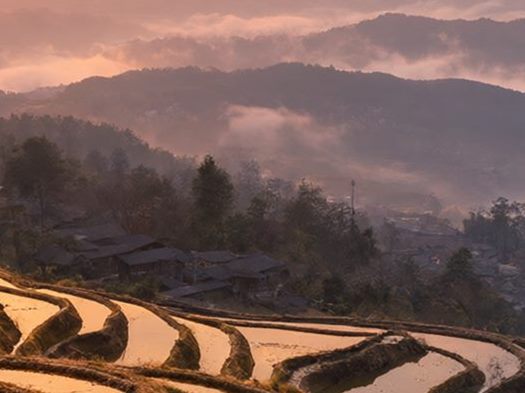
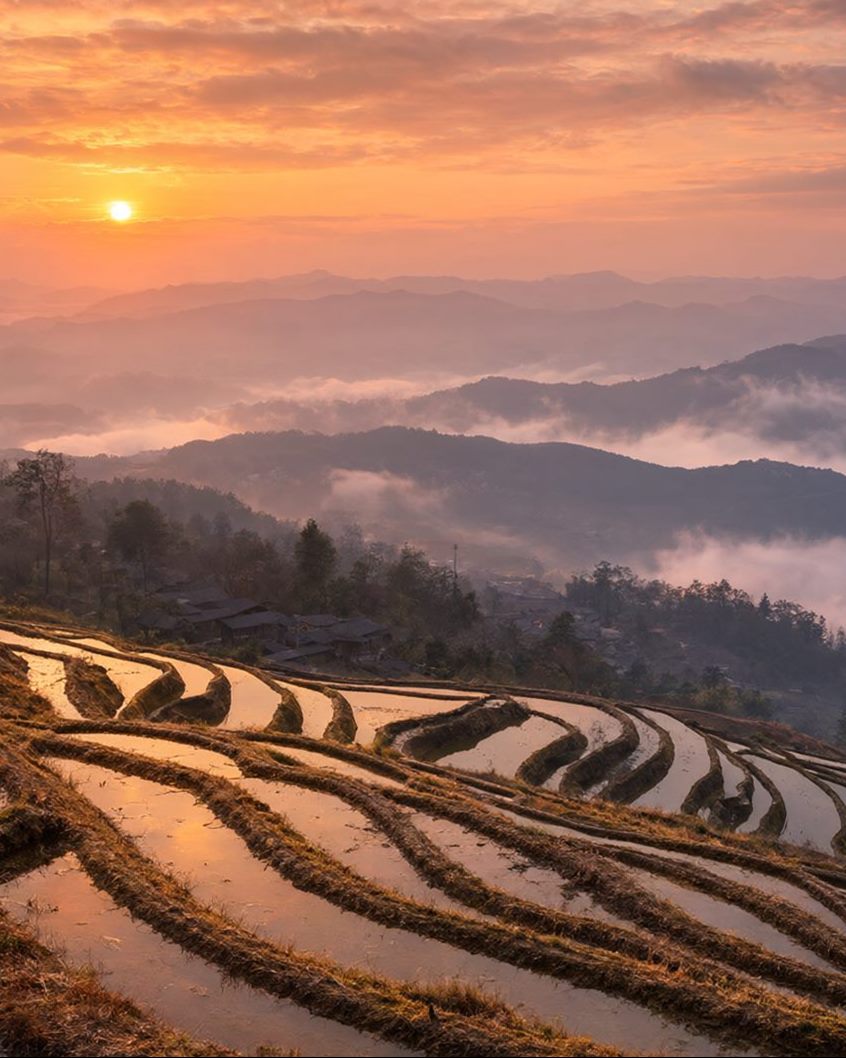
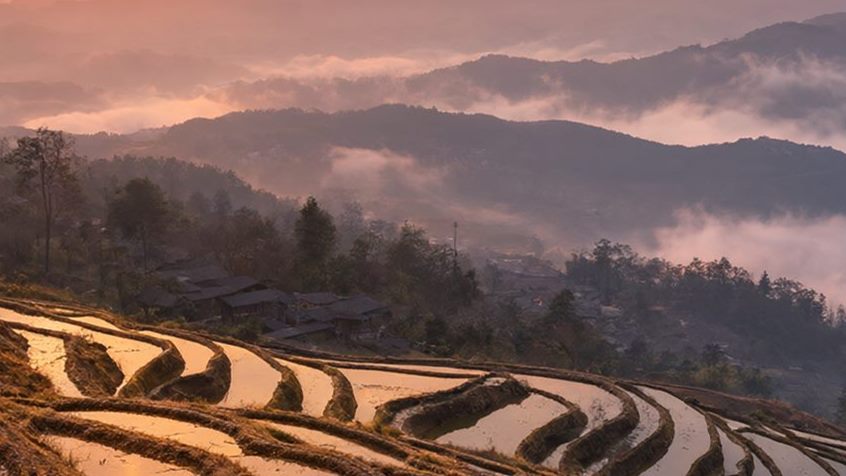
From Jianshui the road climbs for two and a half hours to Xinjie, the county town above the terraces, through banana and then pine. Stay in Xinjie or down at Duoyishu; either way the alarm is at 05:20 and the platform at 06:30, because first light arrives at about 07:38 in January and the colour holds for eleven minutes. The ¥100 pass covers the main viewpoints for three days; buy it before the first dawn, not after.
The awkward day: Yuanyang to Dali
There is no clever way round this: a six to seven hour bus back to Kunming and a two-hour train west, or two hours down to Mengzi, two and a half hours of high-speed rail to Kunming South, a cross-city transfer, and two hours more to Dali. Both take the better part of a day. Leave after the second sunrise, be in Dali by seven, and treat the evening as the reward rather than the plan.
Yunnan rewards the traveller who accepts that every road is a mountain road, and punishes the one who books the afternoon flight. Field desk · Xinjie bus station, 08:40
Dali, Lijiang, and the drift north
Dali is the relaxed one: a lake 40 km across, the Three Pagodas charging ¥75, a walled old town that is more pleasant at eight in the morning, and Xizhou, twenty minutes north, where the market is real and the houses have painted eaves. Two nights, a bicycle, and one meal of Bai fish cooked in beer.
Lijiang is 2 hours away by train and a different proposition: a UNESCO old town that is beautiful at dawn and unbearable at nine, when the tour flags arrive. The trick is to sleep inside it and be out by seven, then spend the day in Baisha or Shuhe, both ten minutes by bike and half a century behind.
Shangri-La, and the last thousand metres
The train from Lijiang takes an hour and twenty and climbs to 3,300 metres, which is high enough to feel. The town is a rebuilt Tibetan trading post with a real monastery above it — Songtseling, a white and gold complex of halls and pilgrim paths that takes two hours and deserves three. Walk the kora at dusk with the pilgrims, sleep badly, and fly out in the afternoon rather than at dawn.
What ten days costs
¥7,500–10,500 per person at mid-range, the cheapest of our longer routes. Guesthouses are ¥150–400 a night; the ¥100 terrace pass and ¥75 at the Three Pagodas are the only large tickets. Buses are ¥60–100 a hop, the two trains ¥150 combined, and the flight out of Shangri-La ¥500–900. Food is the best value in the country: ¥15 noodles, ¥40 for a shared dinner of Yunnan ham and wild greens.
Three things that go wrong here
The single dawn. Fog season means roughly one good morning in three. Book two nights at the terraces or accept that you may photograph cloud.
The altitude. Shangri-La is 3,300 m and the first night is usually poor. No alcohol, no long walk, water by the litre, and keep the flight out in the afternoon.
The transfer day. Do not book an onward train from Dali on the evening of day five. The bus from Yuanyang arrives when it arrives.
Questions travellers ask
- Is ten days enough for Yunnan?
- Enough for the southern loop plus the plateau, with two nights at the terraces and two in Dali. It is not enough to add Xishuangbanna, the Tiger Leaping Gorge trek and the Yulong mountain as well. Pick either the south or the mountains and do that properly.
- When do the terraces fill with water?
- From late December to early March, when the paddies are flooded and empty. Fog is most likely in January, which gives the strongest reflections and the coldest dawns; by April the fields are green and the water is hidden under rice. Plan two mornings, because one can be a white-out.