Field notes · No. 22 · Chongqing
By the ChinaTravel.fly field desk 8 min read Updated Nov 2026
- Lights on
- 19:00–19:30off again around 22:30
- Metro
- ¥2–7Line 2 runs along the river
- Cable car
- ¥20one way over the Yangtze
- Hotpot for two
- ¥150–250with beer, after 22:00
The first thing that happens in Chongqing is that your map fails. Not badly — it knows where the restaurant is — but it does not know that the restaurant is on the twenty-second floor of a building whose entrance is on a road you cannot reach from the road you are on, and that the difference between the two roads is forty metres of cliff and one public lift.
The city sits on a peninsula where two rivers meet, and the peninsula is not flat. It is a ridge with the Yangtze on one side and the Jialing on the other, and everything has been built upward because there was nowhere else. Roads stack. Buildings have entrances at four elevations, each of which is a street. The locals do not find this remarkable. They find it funny that you do.
The eighth floor is a street
Liziba is the famous example and deserves its fame. Line 2, the monorail, runs straight through a nineteen-storey residential block: the train passes between the sixth and eighth floors, in a tunnel built into the building, with apartments above and below. It was designed that way in the 1990s to avoid demolishing the block, and the engineering is quieter than you would expect — rubber mounts, a light train, and a station you can stand underneath.
Stand on the viewing platform below at seven and watch the crowd, which is mostly Chinese visitors filming the same forty seconds on their phones. Then walk up the ramp to the actual street, which is on the ninth floor of the building next door and has a vegetable market on it. Nobody directs you. You work it out by following the shopping trolleys.
In Chongqing you do not navigate by direction. You navigate by altitude, and the only honest question is which way is up. Field desk · Yuzhong, Chongqing
The river, at eight
The lights come on between seven and half past, all at once, on a timer, and the city changes character. Hongyadong is the set piece: eleven storeys of stilt-house pastiche stacked against the cliff above the Jialing, lit in amber, with the Qiansimen Bridge beside it and a crowd on the bridge photographing the crowd on the terraces. It is a reconstruction, it is a shopping centre, and from two hundred metres away it is also genuinely spectacular.
Better: take the ferry across the Jialing for ¥2, or the cable car over the Yangtze for ¥20 one way, and look back. From the water the verticality resolves into a single lit cliff, and you can see the levels — the road at the bottom, the road halfway up, the road on the roof — which is the thing the photographs never show.
The river cruises run ¥100–150 for forty-five minutes and are worth it once, in the same way the cable car is worth it once. Both are better at 20:30 than at 19:00, when the light is fully dark and the crowd on the bank has thinned.
Why the food is horizontal
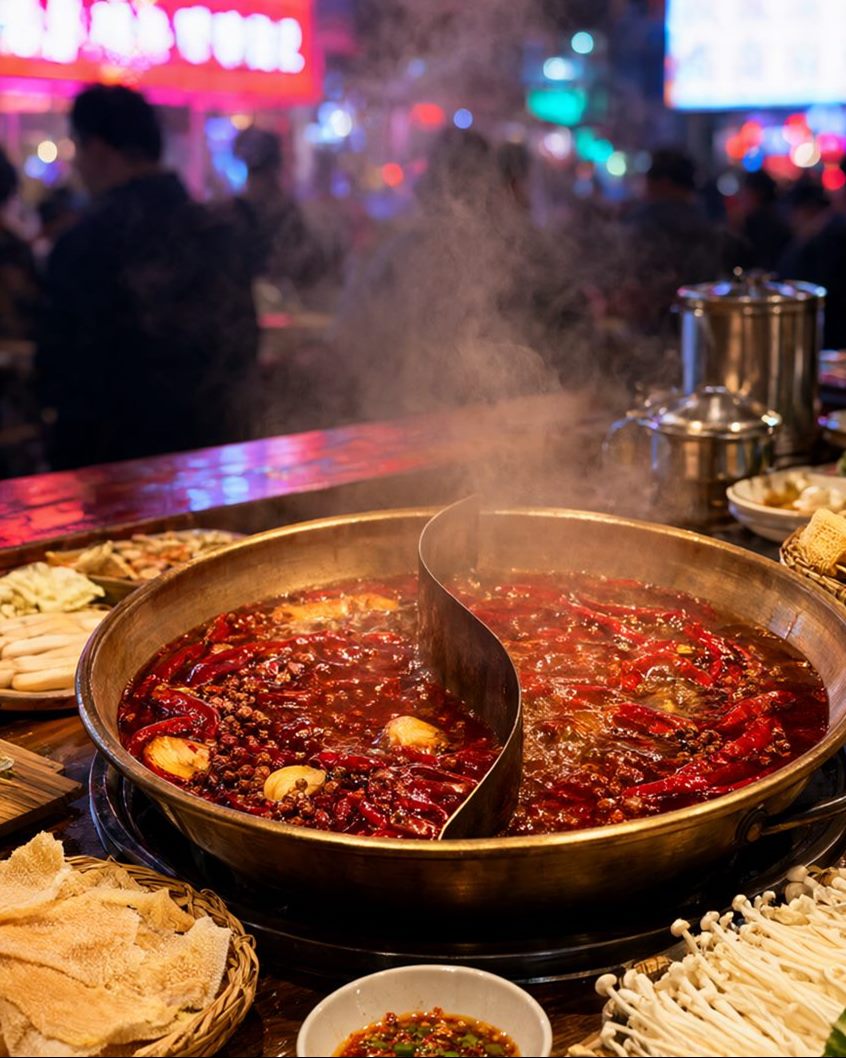
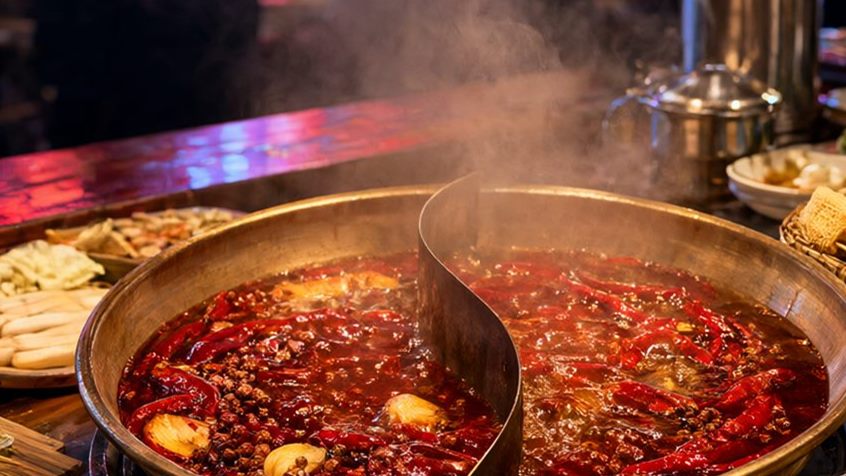
After all that verticality, the eating is flat and slow. Hotpot at midnight is the correct move: a divided pot, beef tallow and chilli on one side, something pale and mild on the other, and a table of things that cook in seconds. Tripe for seven seconds. Duck intestine for ten. A bowl of sesame oil and garlic to dip in, because the oil cools the chilli rather than adding to it.
The bill for two is ¥150–250 with beer. The queue at midnight is shorter than at eight, and the tables outside on the pavement — the only flat surface in the city — fill with people who have just finished work. Order the iced jelly with brown sugar at the end. It is the only thing on the table that is not trying to hurt you.
Two in the morning, still moving
By two the pot has cooled, the pavement tables are being stacked, and the city is still running: escalators between streets, night buses up the ridge, a courier on a scooter with his headlight off. The towers go dark at half past ten. The streets do not. The only thing that stops in Chongqing is the river.
Getting up and down
Metro rides are ¥2–7 and the network is the easiest way to change level; Line 2 along the river is the scenic one. The Yangtze cable car is ¥20 one way, ¥30 return. Public lifts and escalators are free and count as streets.
Taxis will refuse a short trip up a hill at midnight. Didi works, but set the pickup to a named building entrance rather than a road, or the driver will circle below you.
Wear shoes for stairs. The tourist areas are ramps and steps, the pavements are uneven, and a 900 m walk between two metro stations can include 60 m of climb.
Questions travellers ask
- What time do Chongqing's lights come on?
- Between 19:00 and 19:30 depending on the month, and they go off around 22:30. Hongyadong and the bridges are best at 20:30, when the sky is properly dark. The river cruises run until about 21:30.
- Is Chongqing difficult to walk?
- It is steep rather than difficult. Distances on a map underestimate effort because of the climbs, and building entrances can be several floors apart. Use the metro and the public lifts, allow half again as much time as the map suggests, and wear shoes with grip.