Field notes · No. 08 · Lintong
By the ChinaTravel.fly field desk 7 min read Updated Nov 2026
- Ticket
- ¥120passport required; includes the mausoleum site and shuttle
- Pit 1
- 230 mabout 6,000 figures in eleven corridors
- Bronze chariots
- 2half life-size, about a tonne each, some 3,000 parts
- From Xi'an
- 35 kmbus 306 from the station, ¥8, about an hour
The gate opens at half past eight and the car park is already half full, because the tour buses leave Xi'an at seven and the first thing you meet is not the army but a kilometre of souvenir stalls selling miniature armies in Perspex boxes. Walk past them. The site is bigger than the map suggests, the ticket is ¥120 and needs your passport, and the walk to Pit 1 takes ten minutes through a park that is pleasant and entirely invented.
The order that works
Almost everyone goes to Pit 1 first because it is the famous one and it is closest to the entrance. This is the mistake. Go to Pit 3, then Pit 2, then Pit 1, which is the reverse of the coach route and buys you about forty minutes of near-solitude in rooms designed to be looked at slowly.
Pit 3 is the smallest, about 520 square metres, and holds sixty-eight figures, four horses and a chariot. It is the command post: the officers, the guard, the staff. It is also the only pit found intact, with its roof beams and walls still standing, which is why it looks like a room rather than a trench. There is a glass case along one side with the broken figures left exactly as they fell, and almost nobody in front of it, because the coach groups spend seven minutes here.
The faces, at three metres
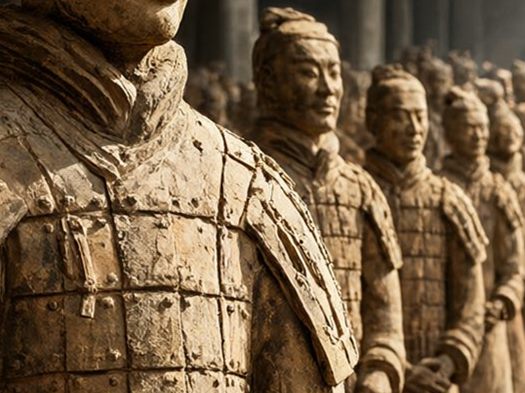
The thing the photographs never prepare you for is that the faces are individual. Not caricatured, not identical with a different moustache: individual, in the way that a room of eight thousand people is individual. There are broad faces and narrow ones, heavy jaws and receding chins, eyebrows done in different hands. The ears are modelled separately. The hair is combed in at least a dozen styles, and the topknots are tied differently on the left and the right, which is an infantry detail rather than an artistic one.
The figures were made in workshops, by conscripted labour, from standard moulds for legs and torsos with the heads and hands finished by hand. Some carry the name of the foreman stamped on a hidden surface. That is the detail that turns the site from a monument into an encounter: eight thousand men, made by people whose names we know, standing in the dark for two thousand years because one man did not want to arrive in the afterlife alone.
You do not look at the terracotta army. You walk into a room where eight thousand people have been standing quietly for two thousand years, and you are the one who is late. Field desk · Lintong, Shaanxi
Pit 1, and the light
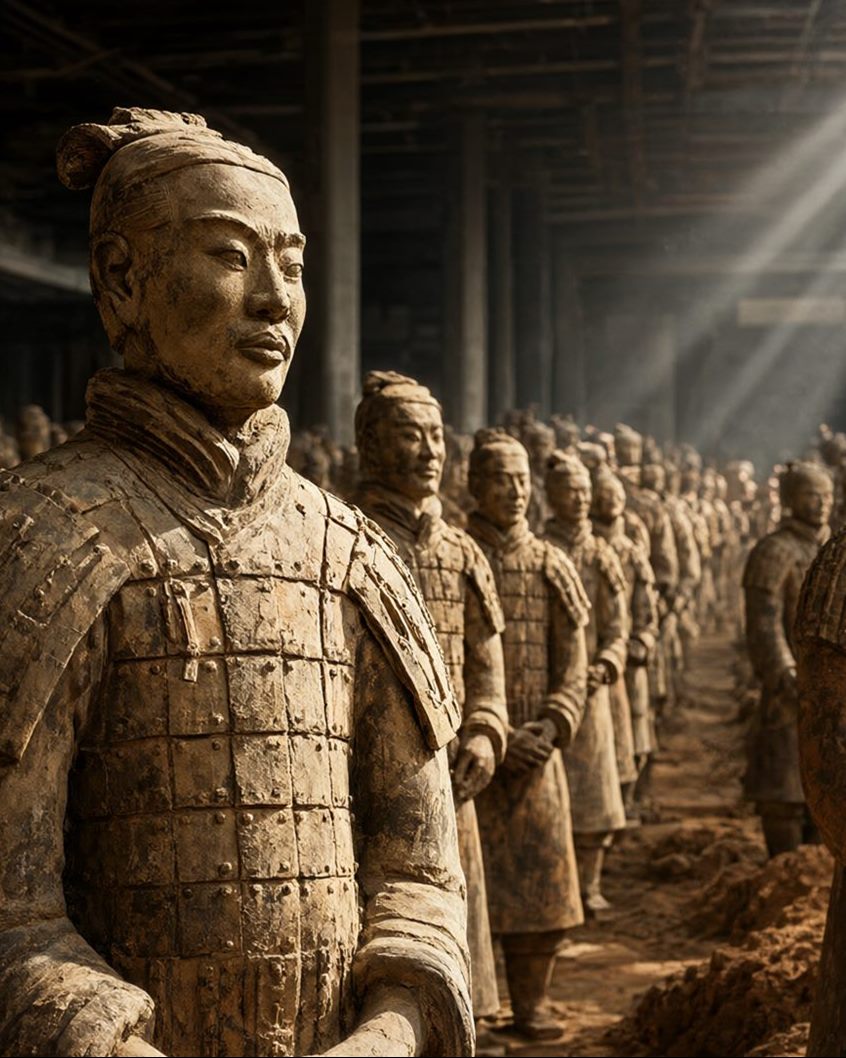
Pit 1 is 230 metres long and 62 wide, covered by a steel hangar with skylights, and the army stands in eleven corridors separated by earth walls. The first rank faces east, toward the entrance, which is why the room feels like it has been waiting for you. In the morning the light comes in from the north and lands on the nearest corridors, and the front figures are lit from the side. By eleven the light is flat and the room is a shed full of clay.
Look for the roof beams. The pit was covered with timber, the timber burned, and the weight of the earth came down on the army in a single event, which is why almost every figure was found in pieces. The reconstructions stand in ranks among figures still half-buried, and at the west end there is a workbench where conservators reassemble a torso from fragments laid out like a jigsaw. The colour is the tragedy: the figures were painted, and the paint flakes within minutes of contact with air.
Beating the coaches
Take the 306 bus from the east square of Xi'an railway station at 7:30. It is ¥8, takes an hour, and drops you at the gate before the first tour group has finished breakfast.
Go 3, 2, 1 and be in Pit 1 by 9:15. Leave by eleven, when the halls fill, and take the free shuttle to the mausoleum site, which is quieter and stranger and included in the ticket.
No tripods and no selfie sticks in the pits. Photography without flash is fine. The site is exposed between halls; bring a hat in summer and expect a 20-minute walk between buildings.
The bronze chariots, and the way out
The two bronze chariots are in a separate hall near the entrance, and most people see them last, which is right. They were found in 1980, twenty metres west of Pit 1, buried in a wooden box that had collapsed: two teams of four horses, a driver, a canopy, each at half life-size and each assembled from something over three thousand pieces. The detail is finer than anything in the pits: the reins, the bit rings, the umbrella ribs, the driver's hands. One weighs about a tonne. They were almost certainly models for the emperor's own carriage.
The site is often described as the eighth wonder of the world, which is the sort of phrase that makes people arrive expecting to be impressed rather than met. We spent three hours and left with a headache from the scale, in the way you get one from a city. On the bus back, a man across the aisle was showing his wife photographs of the same four faces from four angles, and she was looking out of the window at the Wei River, and neither of them was wrong.
Questions travellers ask
- Should you visit Pit 1 or Pit 3 first?
- Pit 3 first, then Pit 2, then Pit 1. Pit 3 is small, intact and nearly empty at opening, and it sets up the story. Pit 1 is the payoff and is best before eleven, when the morning light still reaches the front ranks and the coach groups have not yet filled the walkway.
- How long does the terracotta army take?
- Three hours for the three pits and the bronze chariot hall at a reasonable pace, plus an hour if you take the shuttle to the mausoleum site. Most tours allow ninety minutes, which is not enough. Arrive at opening, work backwards through the pits, and leave by noon.