Where to stay · Beijing
By the ChinaTravel.fly field desk 6 min read Updated Nov 2026
- Hostel
- ¥90–160dorm bed, shared bathroom, sometimes a courtyard
- Mid-range
- ¥450–750private double, three-star, breakfast extra
- Comfort
- ¥1,100–2,000four-star and up, inside the second ring
- First-timers
- Dongchengbetween the palace, the hutongs and Line 5
- Quietest
- XichengJishuitan and the west shore of Houhai
- Families
- Chaoyangspace, parks, lifts and the airport express
- Book
- 6–8 weeksthree months for October and Spring Festival
Beijing is a set of rectangles inside a set of rings, with the Forbidden City at the centre of the smallest one. Where you sleep decides whether the old city is a walk or a commute, which is why the map deserves ten minutes before you book. The distances here are modest in kilometres and large in minutes.
The rings decide more than the district does
The second ring road follows the line of the demolished city wall. Inside it: Dongcheng east of the axis, Xicheng west, the hutongs threaded between them, and nearly every sight within four metro stops. Outside it, Chaoyang runs east with embassies, towers, Sanlitun and the 798 warehouses. The airport express starts at Dongzhimen; Beijing South, for the Shanghai trains, is 25–35 minutes from the centre.
| Area | Nightly | Best for | Trade-off |
|---|---|---|---|
| Dongcheng · Yonghegong and Gulou | ¥450–900 | First trips, hutongs, Line 2 and 5 | Coach mornings; lanes too narrow for cars |
| Dongcheng · Wangfujing and Qianmen | ¥600–1,600 | Walking to the palace, big hotels | Crowds, chains, little neighbourhood left |
| Xicheng · Jishuitan and Houhai | ¥350–750 | Quiet, value, the lakes at dusk | Bar noise on the east shore; 25 min to the palace |
| Chaoyang · Sanlitun and Guomao | ¥700–1,800 | Dinner, bars, business, families | No old city; 20–40 min to anything on Line 10 |
| Courtyard rooms in the hutongs | ¥500–1,200 | Atmosphere, mornings, a courtyard | Thin walls, shared bathrooms, no lifts, damp |
| Beijing South and West | ¥300–600 | One night before an early train | Concrete, nowhere to eat, 30 min to the sights |
A rule of thumb: a room inside the second ring costs 20–30% more than the same room two stops outside it, and buys back 40 minutes a day in transit. For a four-night trip that trade is worth taking. For one night before a train it is not.
Three areas, with the case against each
Yonghegong and the Gulou hutongs
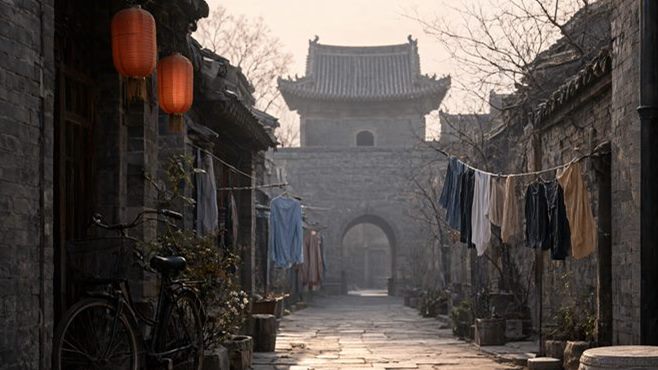
Our first choice for a first visit. From a room near Yonghegong or the Drum Tower you can walk to the lamasery in ten minutes, to Houhai in fifteen, and to the Forbidden City's north gate in half an hour through lanes that still hold a morning market and a primary school. Lines 2 and 5 cross here, so the main station, the Wall buses and the airport are straightforward. The case against: the lanes are dark, cobbled and car-free, so a taxi cannot reach the door, and courtyard rooms are often smaller than the photograph, with the bathroom across the yard.
Xicheng, around Jishuitan
The quiet option. Jishuitan is a Line 2 stop on the north-west corner of the old city, ten minutes on foot from the west shore of Houhai, where the bars thin out and the winter swimmers take over. Rooms cost ¥100–200 less than Dongcheng for the same standard, the streets are residential, and there is a wet market rather than a souvenir row. The case against: 25–30 minutes from the palace by metro, ordinary evening food, and a 15-minute walk to the nearest taxi rank after dark.
Chaoyang, if space matters
Chaoyang is the new city: Sanlitun for dinner, Guomao for towers, Liangmaqiao for families, 798 for a wet afternoon. Rooms are bigger for the money, hotels have pools and gyms, pavements are wide enough for a pushchair, and the airport express begins at Dongzhimen on the district's western edge. The case against is the one that counts: no hutongs, no palace, no old Beijing, and 20–40 minutes on Line 10 whenever you want the city you flew here for.
What 'near the metro' actually means
In Beijing it means less than the listing suggests. The stations are enormous: Dongzhimen, Xizhimen and Guomao each involve five to ten minutes underground between street and platform, and several interchanges have long stairs with no lift at some exits. A hotel advertising 300 metres from Dongsi may be 300 metres from exit B, with another 600 to the platform. Note the exit letter before you surface, and budget 12 minutes door to train. Line 2 is the useful loop for the old city, Line 1 runs east–west beneath Chang'an Avenue, and Line 10 is the outer ring, always full at 8am and 6pm.
The best-located room in Beijing is the one where you can step out at seven, find breakfast, and be at a gate before the coaches. Field desk · Gulou, first week of November
Booking windows and the holiday trap
In a normal week, six to eight weeks ahead is plenty, and the last ten days often bring a small discount. Two exceptions. The first is 1–7 October, when the whole country travels: rooms double or triple and the good ones are gone by August. The second is Spring Festival, whose dates move with the lunar calendar each year; some restaurants close for a fortnight while hotels charge peak rates regardless. Book three months out for either, and read the cancellation terms, because plans move.
The courtyard-room checklist
A courtyard room is the most atmospheric bed in the city and the least standardised. Ask four questions before paying: is the bathroom en suite or across the yard, does the heating work in January and the air conditioning in July, how thin is the wall to the next room, and can a car reach the door or will you carry bags the last 200 metres.
Hotels must be licensed to register foreign guests, and a few budget places quietly refuse at check-in. Confirm in writing that they take foreign passports, and keep the registration slip they give you: police checks at sights occasionally ask for it.
Questions travellers ask
- Where should a first-timer stay in Beijing?
- Inside the second ring, in Dongcheng near Yonghegong or the Drum Tower. The lamasery, the hutongs and Houhai are walkable, the Forbidden City is half an hour on foot, and Lines 2 and 5 cover the rest. Expect ¥450–750 for a private double, and more for a courtyard.
- Is it better to stay near the train station?
- Only for an early departure. Beijing South and Beijing West are traffic islands with little to eat and 30–40 minutes to the sights, and the stations themselves take 20 minutes to cross. Sleep in the centre and leave early, or put a station-side night at the end of the trip, not the start.