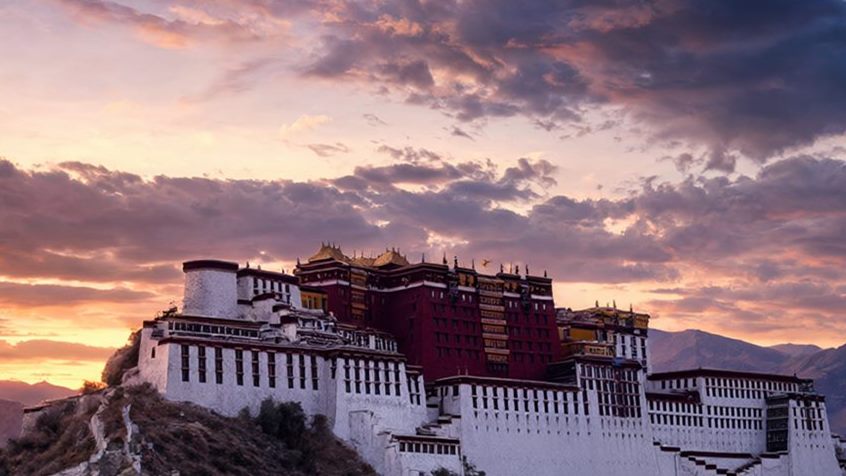
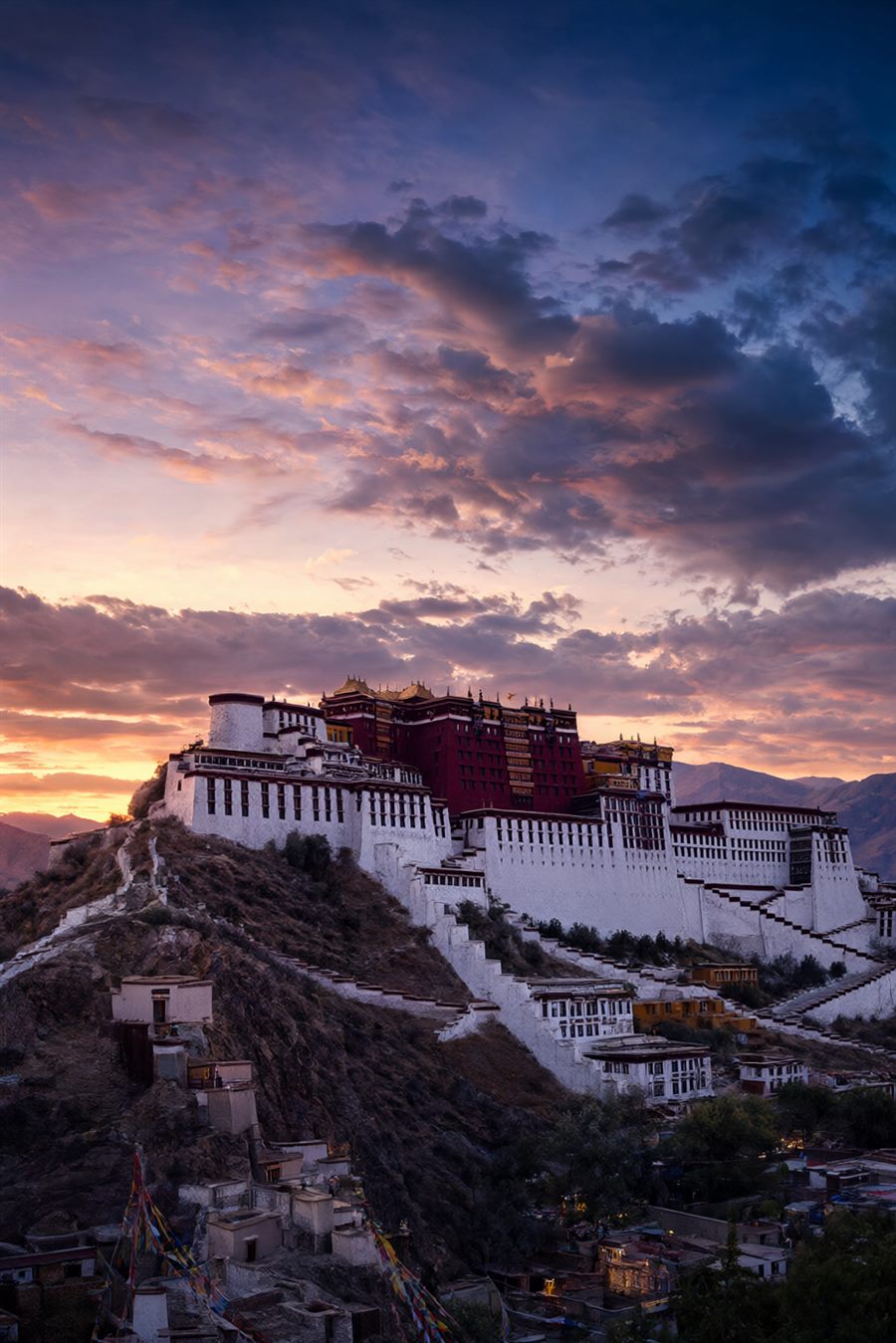
The train from Xining climbs for twenty-one hours, crosses the Tanggula pass at 5,072 metres and sets you down at 3,650. Lhasa is the lowest and easiest of Tibet's cities, which is not the same as easy. The Potala sits above the valley like a held breath; the Jokhang below it is the reason most people came.
拉萨 LāsàTibet Autonomous Region · Western ChinaIdeal 5–6 daysWindow May – Oct
Altitude
3,650 mthe air holds about 65% of sea-level oxygen
Permit
Agency only15–20 days ahead; guide required
Potala
¥200May–Oct; ¥100 in winter; timed slot
Train
21 hXining–Lhasa, soft sleeper, oxygen on board
Airport
LXA60 km southwest; ¥30 shuttle, 60–70 min
Chapter 01 — Orientation
A city at 3,650 metres, arranged around one hill
Lhasa occupies a flat valley floor on the Kyi River, with the Potala on its own rock to the west and the old town about two kilometres east. Between them runs Beijing Road, a wide, unlovely artery of mobile-phone shops and hotels. The Barkhor is a ring of lanes around the Jokhang, and the circuit is walked clockwise. Walk it the other way and you will be gently turned around by the first pilgrim who notices.
The centre is small enough to cross on foot in under an hour, which matters at this height. Sera monastery is five kilometres north, Drepung eight kilometres west, the railway station eight kilometres southwest. The airport is sixty kilometres away in the Gonggar valley, at 3,570 metres — barely lower, which is the point: the altitude starts at the airport door. Foreign travellers can walk freely inside Lhasa, but any road out of the city involves a checkpoint and a permit.
Altitude is the organising fact of the trip, not the sightseeing. At 3,650 metres you are breathing two-thirds of the oxygen you are used to, and the body takes 24 to 48 hours to compensate. The first day is not a sightseeing day. The Potala's few hundred steps are the hardest climb most visitors make all year, and the pilgrims overtaking you are locals who have lived here their whole lives.
Give Lhasa five days: one to arrive, three to look, one to leave. Stay within a few minutes of the Barkhor so that mornings and evenings can be spent on the kora rather than in a taxi. The city rewards slow repetition, and the altitude punishes anything else.
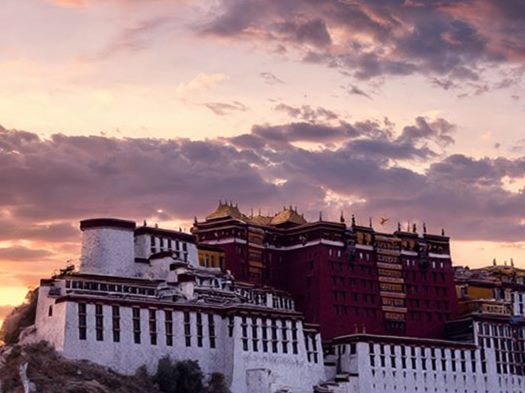
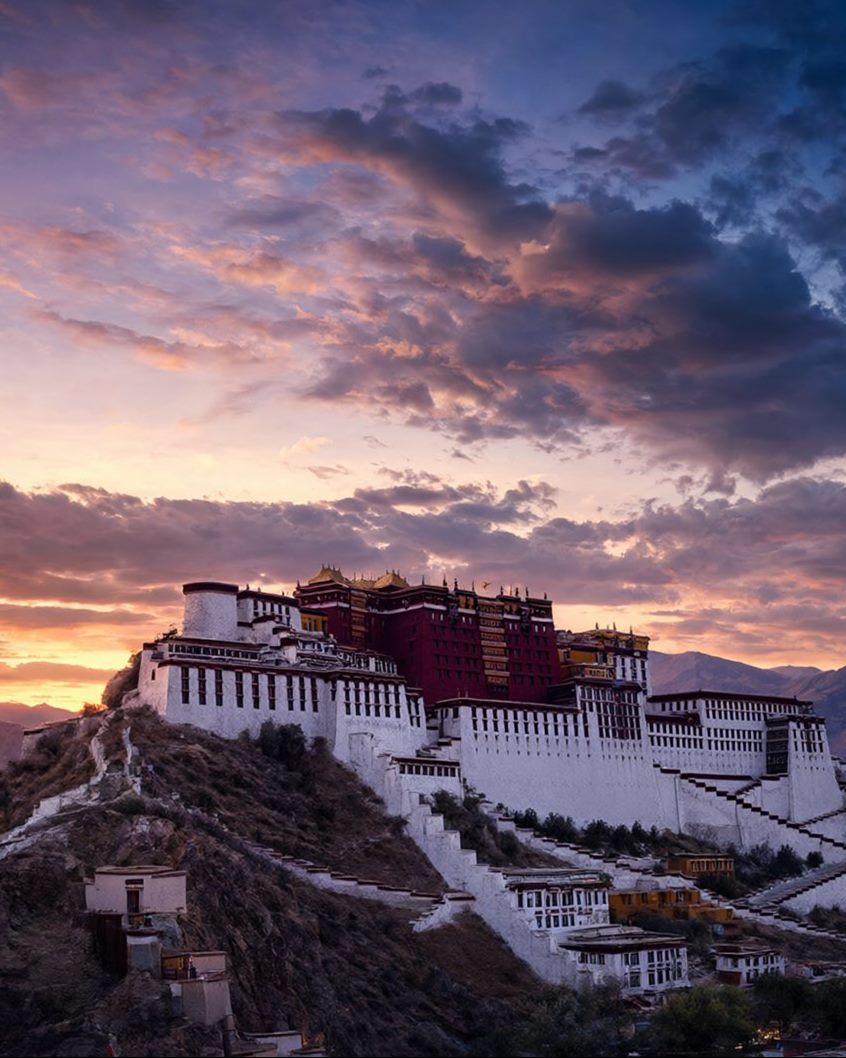
Dusk over the Kyi valleyWhite Palace, Red PalacePrayer flags below the hill
Chapter 02 — Five days
Five days, one of them doing nothing
Day 1 PM
Arrive, then do nothing
The train from Xining arrives around midday. Check in, drink a litre of water and walk no further than the nearest tea house. At dusk, take one slow circuit of the Barkhor, which is flat, busy and the best possible introduction to the city. Eat something plain, skip the beer and be asleep by nine.
Day 2 AM
Jokhang, with the pilgrims
Be at the Jokhang gate at 8:30, when the morning queue is mostly local. The temple is the spiritual centre of Tibet and it feels like it: butter lamps, prostrations, a queue that shuffles forward for an hour. The rooftop, reached by a narrow stair, gives you the whole old town and the Potala in one frame. Spend the afternoon in a sweet tea house doing nothing at all.
Day 3 AM
The Potala, on a timed slot
Book the Potala for mid-morning and allow two hours. The climb from the car park is a few hundred steps, taken slowly with stops. Inside, the visit is paced by guards and photography is banned; the gilded stupas of the Dalai Lamas and the assembly halls are dark, close and heavy with butter. In the afternoon, walk the Norbulingka gardens or the free Tibet Museum, both at valley level.
Day 4 AM
Two monasteries in one day
Drepung at 8:30, before the coach groups, when the whitewashed lanes above the city are quiet; the hillside kora behind it takes an hour and gives you the valley from above. Then Sera for the 15:00 debate, when monks in yellow robes argue in the courtyard with a great deal of clapping. Sit at the edge, keep your camera low and do not walk between the pairs.
Day 5 AM
Fly out, permit in hand
The flight to Chengdu takes two hours and twenty minutes and usually leaves mid-morning. Allow two hours at the airport: the permit and passport are checked at check-in, then again at security. If you have a sixth day, add Ganden monastery, 45 kilometres east and 4,500 metres up, but only if the first four days went well.
Chapter 03 — Six sights
What the altitude lets you see
01 · The hill
The Potala Palace 布达拉宫
Two palaces stacked on one rock: the White Palace, secular and sprawling, and the Red Palace at the centre with the gilded stupas of the Dalai Lamas. Tickets are timed and sold by passport, ¥200 from May to October and ¥100 in winter. Photography is banned inside, bags are scanned, and the route through the chapels is one-way and brisk. Climb slowly; the steps are the test, not the rooms.
¥200 peak9:00–16:00passport + slot2 h
昭
02 · The centre
Jokhang Temple 大昭寺
Founded in the seventh century to house a statue of the young Buddha brought from Nepal, and still the most visited temple in Tibet. The Jowo chapel is the pivot of the whole complex; pilgrims queue for hours to touch its rail. Tourists pay ¥85 and enter from the side. Go early, keep to the edges of the chapels and let the families go first.
¥858:30–18:00mornings for pilgrims1.5 h
转
03 · The kora
The Barkhor 八廓街
A pilgrimage circuit that happens to be lined with shops. The loop is about a kilometre, walked clockwise, past stalls selling prayer flags, butter and fake antiques. At 7am it belongs to Lhasa: old women with prayer wheels, men carrying thermoses, a line of prostrations outside the Jokhang. By noon it is a souvenir market. Walk it at dawn and again at dusk and you will see two different streets.
freeclockwise only1 km loop1–2 h
辩
04 · The debate
Sera Monastery 色拉寺
A working monastery founded in 1419, with whitewashed colleges climbing a hillside five kilometres north of the centre. The afternoon debate is the draw: from about 15:00, monks sit in pairs in a walled courtyard, one questioning, one answering, the question punctuated by a loud clap. It is a genuine monastic exercise, not a performance, so keep distance and put the phone away.
¥50debate 15:005 km north2 h
哲
05 · The largest
Drepung Monastery 哲蚌寺
Once the biggest monastery in the world, home to a reported 7,700 monks before 1959. The buildings spill down a slope eight kilometres west of the city, linked by stairways and alleys that reward an hour of wandering. The hillside kora above the monastery is the best short walk in Lhasa: an hour at a gentle pace, with the whole valley laid out below.
¥608:30–17:008 km west2–3 h
茶
06 · The pause
A sweet tea house 甜茶馆
Sweet tea is black tea boiled with milk and sugar, served in a glass for ¥3–5, or by the thermos for ¥10–20. The tea houses near the Barkhor are unmarked, loud and the cheapest way to spend an hour at altitude. Sit at a shared table, put your money on the table, and someone will pour until it is gone. This is not a sight, but it is the thing you will remember.
¥3–5 a glassall daynear Barkhor1 h
The permit is the trip
Every foreign visitor needs a Tibet Travel Permit, and you cannot apply for one yourself. A registered agency applies on your behalf, usually 15–20 days ahead, using a scan of your passport and Chinese visa. The permit names your route and your guide, and it is checked when you board the train or the flight to Lhasa, then again at road checkpoints.
If you plan to leave Lhasa for Shigatse, Nyingchi or Everest Base Camp, you need a second document, the Aliens' Travel Permit, arranged by the same agency. Do not book non-refundable flights before the permit is confirmed; permits are refused, and dates move. Carry the paper copy, not a photo, and keep it with your passport.
Questions travellers ask
Do you need a permit to visit Lhasa?
Yes. Every foreign visitor needs a Tibet Travel Permit, arranged through a registered agency at least 15–20 days ahead; you cannot apply yourself. The permit lists your route and guide, and it is checked when you board the train or flight and at road checkpoints. Add the Aliens' Travel Permit for areas beyond Lhasa, such as Shigatse or Nyingchi.
How bad is the altitude in Lhasa?
Lhasa sits at 3,650 metres, where the air holds roughly 65 per cent of the oxygen at sea level. Most people feel breathless for 24–48 hours. Take the first day off, drink water, avoid alcohol and leave the Potala steps until day three. Ask a doctor about acetazolamide before travelling, and descend if symptoms get worse rather than better.
Should you take the train or fly to Lhasa?
The train from Xining takes 21–22 hours, crosses the Tanggula pass at 5,072 metres and is the gentler way to acclimatise, especially in a soft sleeper. Flying is faster but drops you at altitude with no adjustment. The sensible combination is train in, fly out, which gives you the crossing and saves two days at the end.