Field notes · No. 14 · Yuanyang
By the ChinaTravel.fly field desk 7 min read Updated Nov 2026
- Mirror months
- Dec–Marflooded and unplanted; the reflection is the point
- Entry pass
- ¥70–100covers the main viewpoints for three days
- Altitude
- 1,400–2,000 mcool nights, strong sun, no altitude problems
- From Kunming
- 5–6 h330 km by expressway; Jianshui is 3 h away
The alarm went at twenty past five in a guesthouse in Xinjie, the county town, where the kettle had a thin skin of ice on it. Duoyishu is forty minutes away by road, uphill and then down, and its platform is the most photographed sunrise in Yunnan and the least convenient. We were in the car by five forty with a bag of steamed buns and no confidence at all, because the sky was clear and the valley below was full of cloud.
The 5:20 alarm, and why you take it
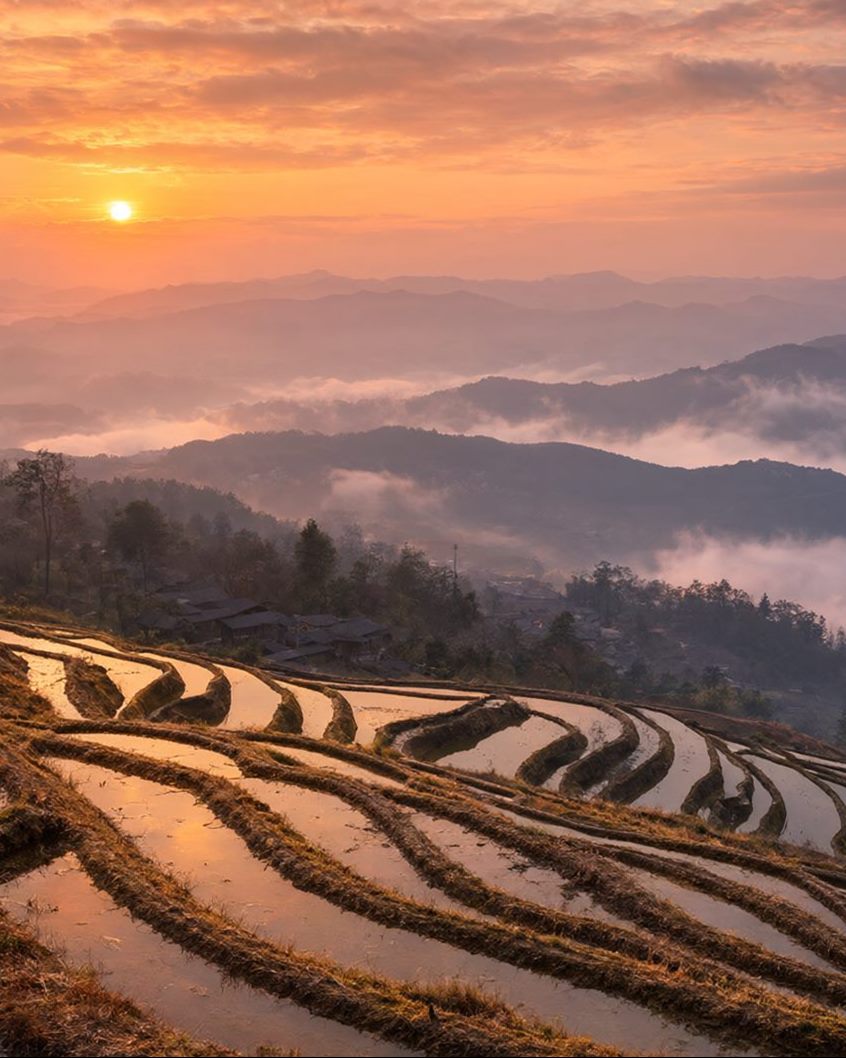
The terraces were built by the Hani over roughly thirteen hundred years, on slopes so steep that a single hillside can carry three hundred levels. They are a water system, not a scenic construction: forest at the top holds the rain, channels carry it down through the village, and each field takes its share before passing the rest on. In December the rice is off and the fields are flooded, which turns the valley into a broken mirror, and that is when the photographers come.
Which viewpoint, which hour
Duoyishu faces east and is the sunrise platform: a concrete terrace with a covered pavilion, a ticket gate, and room for perhaps eighty people, which is how many arrive on a January morning. Bada is broader and better at sunset, with a view down a valley that looks like a topographic map. Laohuzui, Tiger's Mouth, is the classic sunset shot, a bowl of terraces with a village on the rim, and the most crowded. Jingkou and Quanfuzhuang are quieter and worth an hour if you have a car.
The sun clears the eastern ridge at about 7:38 in January, 7:15 in February and 6:40 by April. The good light is the ten minutes after that, when the water takes the colour of the sky and the terraces light up from the valley floor upward, one bank at a time. Then it is over. By eight the light is white, the water is grey and the platform is emptying, and the people who arrived at seven are photographing nothing in particular.
The terraces do not perform. They are a farm that happens to be beautiful when it is full of water, and the fog has no interest in your alarm. Field desk · Duoyishu, Yuanyang County
The fog is the whole gamble
Fog forms on clear, still, humid nights, which is most nights in winter. The ideal is a sea of it below the platform with the tops of the terraces above the waterline, which happens perhaps one morning in three. Too much and you see nothing. Too little and the valley is dark and the reflection is flat. Wind is the enemy: a breeze at dawn breaks the mirror before the sun is high enough to make broken water interesting.
You can read the morning from the guesthouse. If the sky is clear at five and there is no wind in the valley, go. If it is raining, sleep, and go to the market in Shengcun instead.
The villages behind the water
The Hani villages sit at the top of the water system, which is why they are where they are. Pugaolao is the one everyone photographs: mushroom-shaped houses of mud and thatch, a village square, a sacred grove above it that is never cut. Duoyishu village is bigger and less picturesque, with a school and a basketball hoop. Shengcun has the market, on a rotating schedule, and the smell of it reaches you before the stalls do.
The villages are poor in cash and rich in work. Every terrace you photographed at dawn is maintained by hand: the bank repaired with mud, the channel cleared with a hoe, the water let in and shut off on a rota that predates any government. One woman, walking down from a field with a basket of greens, stopped to tell us, through a granddaughter, that the water is better in February. She was right.
Reading the morning
Sleep in Duoyishu or Xinjie, not Kunming. The drive from Kunming is five to six hours and there is no version of the sunrise that begins with a 2am departure.
Take the multi-site pass and give it two mornings. Buy it at the Qingkou ticket office; the gate at Duoyishu opens at 6:00 and the platform is full by 6:45 in January.
Dress for 5°C at dawn and 22°C at noon. Frost is normal in January; the sun is strong by ten. Bring a headlamp, cash for the village stalls, and shoes with grip for the mud.
After sunrise, the valley is still there
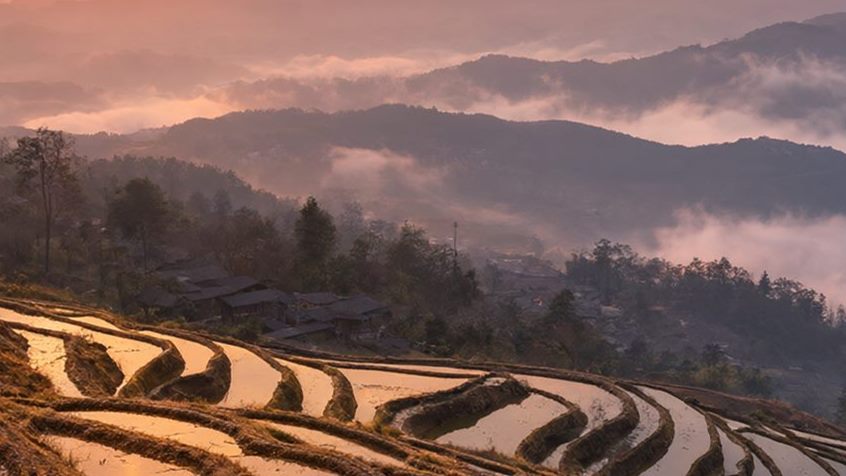
The mistake is to treat Yuanyang as a dawn appointment and leave by ten. The terraces in flat midday light are ordinary; at four in the afternoon, with the sun low and the banks casting curved shadows, they are better than anything at dawn except the water. Walk down into them. A path from Duoyishu village drops to the valley floor in about an hour, and from inside the system the scale changes: each field is the size of a room.
We drove back to Xinjie in the dark, ate rice noodles with pickled vegetables for ¥12, and set the alarm for five fifteen again. The second morning the fog sat exactly where it should: a white lake below the platform, the tops of the terraces above it, and the sun arriving at 7:36. It lasted eleven minutes. Nobody said anything, which is the highest compliment a view can be paid.
Questions travellers ask
- When is the best time to see the Yuanyang terraces?
- December to March, when the fields are flooded and unplanted and act as mirrors. January and February give the most reliable fog and the strongest reflections, though mornings are cold. April to June is green and less photogenic; September and October are gold with the rice standing.
- How many days do you need in Yuanyang?
- Two nights is the practical minimum: one sunrise, one sunset, and a walk down into the terraces in between. Three nights lets you add the Shengcun market and a second sunrise, which matters because a single dawn is a coin toss in fog season. The multi-site ticket is valid for three days.