Field notes · No. 34 · Harbin
By the ChinaTravel.fly field desk 7 min read Updated Nov 2026
- Gate
- 11:00–21:30last entry 21:00; the lights come on about 16:15
- Ticket
- ¥328adult; slides and most shows included
- Blocks
- 0.5–1 mcut from the Songhua in December and stacked by crane
- Super slide
- 300 m+several lanes; the queue runs 30–60 minutes after six
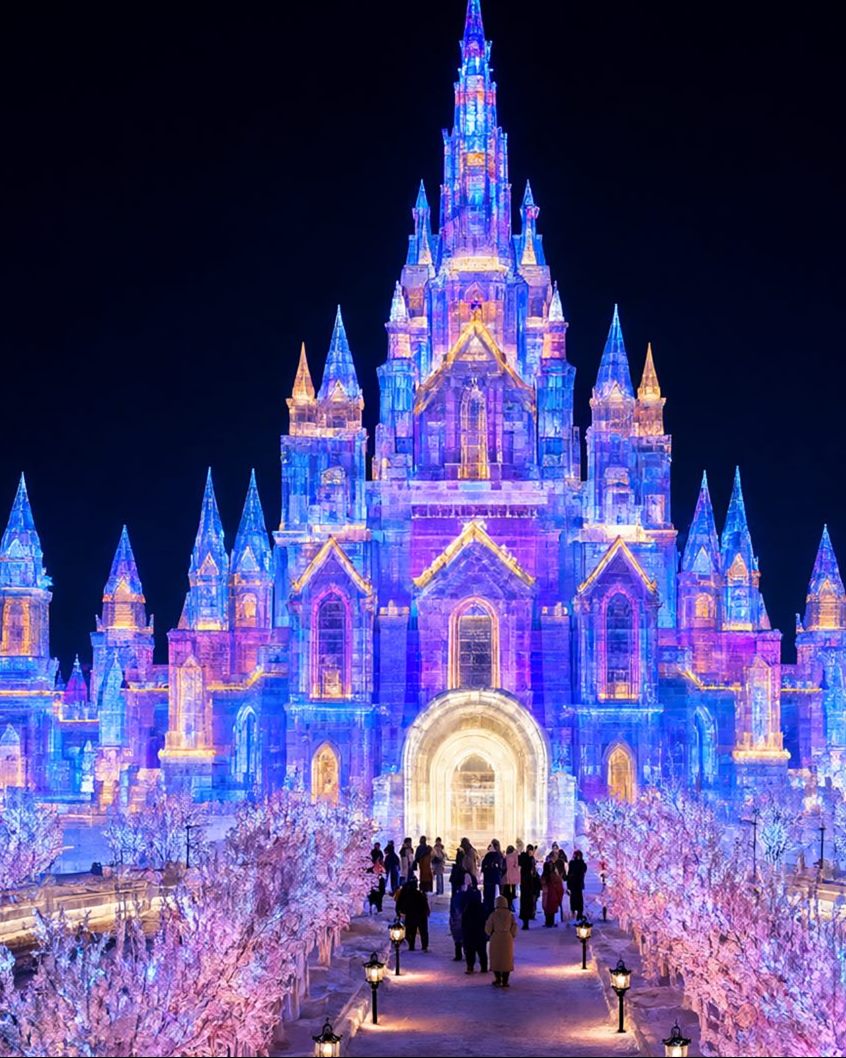
You arrive in daylight and it is a building site. Grey-white blocks, cranes, a few towers half-clad, a man in an orange jacket dragging a hose. The ice is not blue in daylight; it is the colour of an old fridge, and the scale is legible. Then the sun goes behind the far bank at about a quarter past four, the sky turns the specific deep blue of a northern winter, and the site switches itself on.
This is the moment worth paying for, and it lasts twenty minutes. The towers come up one at a time as the crews finish their circuits, and a construction site becomes a city with a horizon. By half past four the crowd is arriving in a river of hoods, and everyone stops dead in the entrance to photograph the same tower.
The light is the architecture
The ice is a material with one trick: it carries light. Every structure here is built around LED strip buried between the blocks, and the colour is chosen by somebody who has thought about it more than you have. The palette runs blue, violet, cyan and a cold magenta, with white for the palaces and amber for the food halls. It is not decorative; it is what turns a pile of frozen water into a nave.
Look closely at a wall and you can see the seams, the bubbles, the cracks, and the rebar of light running through like a nervous system. The blocks are cut from the Songhua in December, hauled out in slabs half a metre to a metre thick, and stacked with cranes into arches and towers that will be a puddle by March. The design changes every year, which is why nobody can tell you what it looks like, only what it does.
The slide, and the queue for it
The super slide is the reason half the people under twenty are here. It is more than three hundred metres of chute cut into a wall of ice, with several lanes and a rubber mat that you sit on, and it is genuinely fast: forty seconds, wind in the face, and a run-out at the bottom that is longer than it looks from the top. It is included in the ticket. The queue for it is not.
At six the wait is thirty to forty minutes, standing still, at minus twenty-five. At eight it is an hour. There are smaller slides for children and a few short free ones at the edges of the site, and if you have any sense you will do those instead and spend the saved hour walking the towers. If you do queue, do it early, take a mat from the pile without arguing about which one, and keep your gloves on until the last second. Head first is not allowed and the staff are serious about it.
The lights do not make the ice beautiful. They make it legible: a colour for each tower is how you find your way back to the gate in the dark. Field desk · Sun Island, Harbin
Cold at nine o'clock
The cold is not a constant. It accumulates. For the first hour you are warm from the walk and the crowd; by the second your face is numb in a way that makes smiling feel like a decision; by the third, at around nine, the cold has reached your feet through two pairs of socks and the only thought left is where the nearest heated room is. There are warming huts and food halls, and they are full of people sitting on the floor with their boots off, which is not a metaphor.
The trick is to treat the site as a series of twenty-minute exposures with warm intervals, rather than one long walk. Tower, hut, tower, hut. Drink something hot at the stalls — milk tea, ginger tea, ¥15–25 — and eat the sausage on a stick that every second person is holding. The cold does something useful too: it empties the far corners, and the ice labyrinth at the eastern end, which is a mob at six, is completely silent by half eight.
The exit, which is the real event
At half nine the announcement goes round and 30,000 people decide to leave at once. The gate narrows, the wind comes across the open car park, and the queue for the shuttle buses runs back into the site. This is the part nobody photographs and everybody remembers. There are buses to the metro and to the city, they are free with most tickets, and they are warm, which is enough.
Outside, the taxis are waiting in a line that is not a line, and the men calling you toward unmarked cars will want ¥100–150 to Central Street, against ¥30–40 on the meter. Harbin's metro Line 2 has a station at the site, which is the sane option: two stops to the centre, ¥2–4, and no negotiation in the cold. It closes around half nine, so if you are staying for the last hour, you are taking the bus or paying the man.
Getting out, and back
Arrive at three, not at six. You get the daylight version, the switch-on at four, and two hours before the site fills. The ticket covers everything; the only thing worth queueing for is the big slide, and only if you are there before half five.
Keep the metro in mind and check the last train, which is earlier than the site closes. Cash for the stalls, a power bank inside your coat, and a plan for the twenty minutes between the gate and the bus. The cold at the exit is the coldest twenty minutes of the night.
Questions travellers ask
- What is the best time to visit Harbin Ice and Snow World?
- Arrive around three in the afternoon. You see the site in daylight when the scale is readable, the lights come on at about a quarter past four, and you have two hours before the evening crowd. Stay until eight, then leave before the 21:30 exit rush. The ticket is the same whenever you go.
- How do you get back from Ice and Snow World at night?
- The free shuttle buses run to the city and to the metro until the site closes. Metro Line 2 has a station at the site, costs ¥2–4, and stops around 21:30. Taxis outside will quote ¥100–150 to Central Street against a metered ¥30–40, so agree the meter or use the bus.