Region · Northwest & Tibet
By the ChinaTravel.fly field desk 7 min read Updated Nov 2026
The Silk Road in China is a corridor, not a road: a 2,000-kilometre strip of oases between the Qilian mountains and the Gobi, threaded by rail and highway, with a chain of towns that grew rich on the trade between Xi'an and Samarkand.
The corridor, west to east
Start in Xi'an, the eastern terminus, where the clay army and the Ming wall are the warm-up. Then Lanzhou for the Yellow River and the hand-pulled noodles. Then the Hexi Corridor: Zhangye's rainbow rock, Jiayuguan's fort at the end of the wall, and finally Dunhuang, where the Mogao caves hold a thousand years of painting in 735 cut chambers.
Above all of it, reached by a separate permit and a different railway, sits the Tibetan plateau. Lhasa at 3,650 metres is the destination; the 21-hour train from Xining is the approach, with oxygen piped to the berths and a landscape that keeps changing altitude.
Distances, honestly
| Leg | By rail | Note |
|---|---|---|
| Xi'an → Lanzhou | 3 h | high-speed |
| Lanzhou → Zhangye | 3 h | high-speed |
| Zhangye → Dunhuang | 5 h | or fly 1 h |
| Dunhuang → Urumqi | 11 h | sleeper is normal |
| Xining → Lhasa | 21 h | oxygen train |
The Silk Road is not a route you complete. It is a route you keep stopping on. Field desk · Hexi Corridor
When it works
May, June, September and early October are the corridor's good months: hot days, cold nights, clear light. July and August are crowded with domestic tour groups and hot enough to make the dunes unpleasant at midday. Winter is empty and beautiful and cold, with some caves closed.
Tibet is a narrower window: June to September, when the passes are open and the plateau is green. The altitude is the real constraint, not the weather — give Lhasa two full days before anything else, and do not fly in from sea level and immediately climb.
What nobody tells you
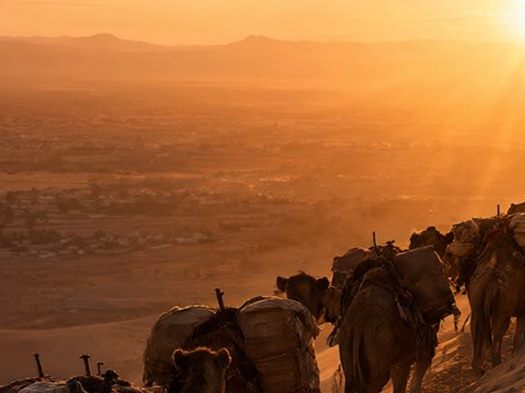
Dunhuang is small enough to walk in a morning and strange enough to stay three days. The night market is a tourist set piece, but the dunes at 6pm are not — climb the ridge, sit down, and watch the camel trains come back in a line.
For Tibet, the permit is arranged through a licensed agency as part of a tour or driver package. There is no independent route, and the rules tighten around sensitive dates.
Questions travellers ask
- Do you need a permit for Tibet?
- Yes. Foreign travellers need a Tibet Travel Permit, arranged through a licensed agency as part of a tour or driver package, plus a Chinese visa. The permit is checked on the train and at the airport, and cannot be obtained independently.
- How many days does the Silk Road need?
- Ten to twelve days from Xi'an to Dunhuang by rail, with stops in Lanzhou, Zhangye and Jiayuguan. A tighter version flies Xi'an to Dunhuang and does the corridor backwards in six days, but you lose the sense of distance that makes the region.